

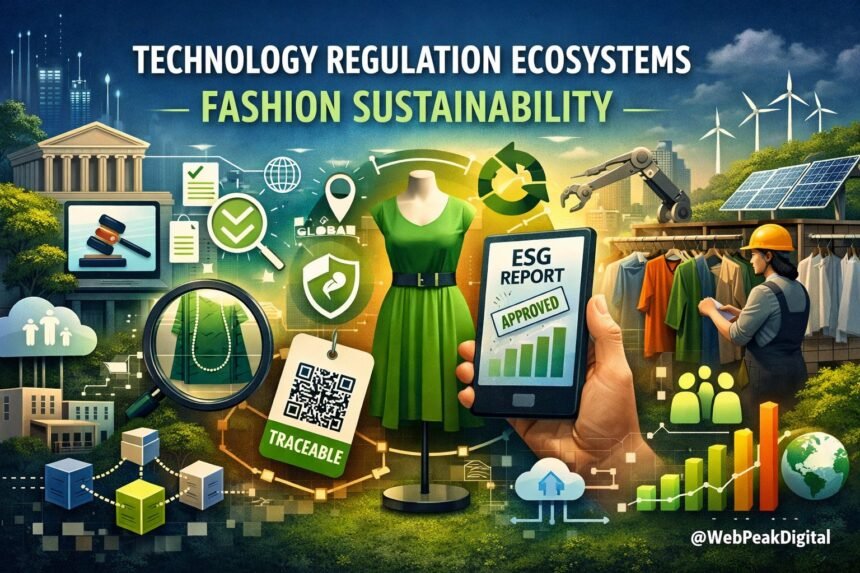
Technology, regulation, and sustainability are no longer separate conversations in the fashion industry. As supply chains stretch across borders and scrutiny increases from regulators, investors, and consumers, brands are being pushed to prove—not just promise—their environmental and social performance. This shift has moved sustainability from marketing teams into compliance, operations, and data systems, where accountability can be measured and enforced.
The concept of technology regulation ecosystems fashion sustainability reflects this new reality. It describes how digital tools, regulatory frameworks, and industry stakeholders are increasingly interconnected to manage risk, ensure transparency, and drive measurable outcomes. Instead of relying on isolated audits or voluntary disclosures, the industry is moving toward coordinated ecosystems where policy requirements are translated into real-time data, standardized reporting, and enforceable action across the fashion value chain.
What Are Technology Regulation Ecosystems in Sustainable Fashion
Definition and Core Components
Technology regulation ecosystems in sustainable fashion are structured networks where digital systems, regulatory rules, and industry actors work together to manage environmental and social impact. They exist to turn policy requirements into operational reality.
These ecosystems usually include:
- Regulatory frameworks that define sustainability rules
- Technologies that collect, verify, and report data
- Stakeholders who act on, enforce, or audit outcomes
The system only works when rules, data, and accountability are connected.
How Fashion Sustainability Fits Into Regulatory Ecosystems
Fashion sustainability fits into these ecosystems as a high-risk, high-impact sector that requires constant oversight. The industry’s global supply chains make regulation impossible without technology.
This alignment happens through:
- Tracking materials, labor, and emissions digitally
- Standardizing sustainability metrics across regions
- Embedding compliance into daily operations
Without ecosystem coordination, sustainability rules remain theoretical.
Evolution of Tech-Led Sustainability Governance
Tech-led sustainability governance has evolved from voluntary reporting to enforceable, data-driven oversight. Early sustainability programs relied on self-declared claims.
The shift occurred as:
- Regulators demanded verifiable data
- Digital traceability became scalable
- Investors pushed for consistent ESG metrics
Governance now depends on systems, not statements.
How Technology Regulation Ecosystems Function in Practice
Policy-Driven Innovation Cycles
Policy-driven innovation cycles occur when regulations create demand for new tools and systems. Compliance requirements force technology adoption.
This cycle follows a clear pattern:
- Regulation sets minimum standards
- Technology providers build compliance solutions
- Brands adopt tools to meet obligations
- Regulators refine rules based on data quality
Policy and innovation move together, not separately.
Data Flow Between Brands, Platforms, and Regulators
Data flows continuously between brands, technology platforms, and regulators to maintain oversight. Sustainability data is no longer static or annual.
Typical data movement includes:
- Supplier-level input at production stages
- Platform-based aggregation and validation
- Regulator or auditor access for review
Clear data flow reduces disputes and delays.
Enforcement, Reporting, and Feedback Loops
Enforcement relies on structured reporting and feedback loops. Regulators use reported data to identify gaps and risks.
Effective loops involve:
- Automated reporting schedules
- Threshold-based alerts for non-compliance
- Corrective actions tied to future approvals
Feedback improves both regulation and operational behavior.
Key Stakeholders and Their Roles
Governments and Regulatory Authorities
Governments define sustainability expectations and enforcement mechanisms. Their role is to translate policy goals into measurable obligations.
They typically:
- Set reporting standards
- Approve compliance frameworks
- Enforce penalties or incentives
Their influence shapes the entire ecosystem.
Fashion Brands and Manufacturers
Brands and manufacturers are responsible for execution. They must integrate sustainability into sourcing, production, and logistics.
Their role includes:
- Collecting accurate supply chain data
- Implementing compliance tools
- Correcting violations quickly
Operational discipline determines ecosystem success.
Technology Providers and Platforms
Technology providers supply the infrastructure that makes compliance possible. They convert rules into usable systems.
Their responsibilities often include:
- Data capture and validation
- Secure recordkeeping
- Reporting automation
Poor technology choices create compliance risk.
NGOs, Auditors, and Standards Bodies
NGOs and standards bodies provide credibility and oversight. They act as neutral validators.
They support ecosystems by:
- Defining benchmarks
- Conducting independent audits
- Challenging weak or misleading claims
Their involvement reduces greenwashing risk.
Why Regulation-Driven Technology Ecosystems Matter
Environmental and Social Risk Reduction
These ecosystems reduce environmental and labor risks by making problems visible early. Hidden issues are harder to ignore when data is traceable.
Key impacts include:
- Faster detection of supply chain violations
- Measurable emission reductions
- Improved labor condition monitoring
Risk management becomes proactive, not reactive.
Market Transparency and Consumer Trust
Transparency improves trust when claims can be verified. Consumers increasingly expect proof, not promises.
This happens through:
- Traceable product histories
- Verified sustainability labels
- Consistent disclosures
Trust is built on access to evidence.
Long-Term Industry Resilience
Regulated ecosystems support long-term stability by aligning incentives. Brands that adapt early face fewer shocks.
Resilience improves because:
- Compliance becomes predictable
- Data supports better planning
- Supply chains become more accountable
Stability benefits the entire market.
Benefits for Fashion Brands and Retailers
Improved Supply Chain Visibility
Technology-enabled ecosystems give brands real visibility into multi-tier supply chains. This visibility replaces assumptions with data.
Brands gain:
- Material origin tracking
- Labor condition monitoring
- Emission measurement across stages
Visibility reduces operational blind spots.
Faster Compliance and Reporting
Automated systems shorten compliance cycles. Reporting shifts from manual effort to structured processes.
This leads to:
- Lower administrative burden
- Fewer reporting errors
- Faster regulatory responses
Speed matters under strict deadlines.
Competitive Advantage Through Verified Sustainability
Verified sustainability creates defensible differentiation. Claims backed by data carry more weight.
Advantages include:
- Stronger investor confidence
- Reduced reputational risk
- Better positioning in regulated markets
Verification separates leaders from laggards.
Benefits for Regulators, Investors, and Consumers
Standardized Sustainability Data
Standardized data allows comparison across brands and regions. It reduces ambiguity.
Standardization enables:
- Fair benchmarking
- Cross-market analysis
- Policy effectiveness tracking
Consistency improves decision quality.
Reduced Greenwashing and Fraud
Technology-backed regulation limits false claims. Data trails expose inconsistencies.
This reduction happens through:
- Immutable records
- Third-party verification
- Automated checks
Fraud becomes harder to hide.
Better ESG Decision-Making
Reliable data supports better ESG decisions by investors and policymakers. Guesswork is minimized.
Decision-makers benefit from:
- Comparable disclosures
- Verified performance metrics
- Clear risk indicators
Capital flows follow credible data.
Best Practices for Building Sustainable Fashion Ecosystems
Integrating Technology Early in Compliance Planning
Early integration prevents last-minute fixes. Technology should be part of compliance design, not an add-on.
Effective planning includes:
- Mapping regulatory requirements
- Selecting scalable systems
- Testing data quality early
Late adoption increases risk and cost.
Aligning Internal Teams With Regulatory Requirements
Compliance fails when teams work in silos. Alignment ensures consistent execution.
Best alignment practices involve:
- Shared data standards
- Clear accountability
- Cross-functional training
Coordination improves accuracy.
Collaborating Across the Supply Chain
Ecosystems require cooperation beyond direct suppliers. Data gaps often exist deeper in the chain.
Collaboration improves when:
- Expectations are clearly communicated
- Tools are accessible to suppliers
- Incentives support compliance
Shared responsibility strengthens outcomes.
Regulatory and Compliance Requirements Shaping the Ecosystem
ESG Reporting and Disclosure Obligations
ESG reporting obligations require structured, auditable disclosures. Informal reporting is no longer acceptable.
Key expectations include:
- Consistent metrics
- Evidence-backed claims
- Regular updates
Reporting drives accountability.
Supply Chain Due Diligence Expectations
Due diligence rules require brands to assess and address risks throughout supply chains. Responsibility extends beyond direct control.
This includes:
- Risk identification
- Mitigation actions
- Ongoing monitoring
Due diligence is continuous, not one-time.
Digital Product and Traceability Mandates
Digital traceability mandates require product-level data records. These records follow items through their lifecycle.
Mandates typically require:
- Material composition disclosure
- Production location data
- End-of-life information
Traceability supports circular models.
Common Challenges, Risks, and Failures
Data Accuracy and Interoperability Issues
Data accuracy problems weaken trust. Interoperability gaps prevent system integration.
Common causes include:
- Manual data entry errors
- Incompatible platforms
- Inconsistent definitions
Poor data undermines compliance.
Cost and Complexity for Small Suppliers
Small suppliers often struggle with system costs and complexity. This creates uneven compliance.
Challenges include:
- Limited technical capacity
- Upfront investment barriers
- Training requirements
Support mechanisms are critical.
Misalignment Between Global Regulations
Global brands face conflicting rules across regions. Misalignment increases operational burden.
This results in:
- Duplicate reporting
- Conflicting standards
- Increased compliance risk
Harmonization remains limited.
Technologies Powering Fashion Sustainability Ecosystems
Blockchain and Traceability Systems
Blockchain systems provide tamper-resistant records. They support trust in shared data environments.
They are used for:
- Material provenance tracking
- Transaction verification
- Audit support
Blockchain adds credibility, not speed.
AI and Predictive Sustainability Analytics
AI tools analyze large datasets to identify risks and trends. They support proactive decision-making.
Applications include:
- Emission forecasting
- Supplier risk scoring
- Demand optimization
AI improves insight, not judgment.
IoT and Real-Time Environmental Monitoring
IoT devices collect real-time environmental data. They reduce reliance on estimates.
Typical uses involve:
- Energy monitoring
- Water usage tracking
- Emission measurement
Real-time data improves accuracy.
Actionable Framework for Fashion Sustainability Leaders
Assessing Regulatory Exposure
Regulatory exposure assessment identifies where rules apply and where risks exist. It guides prioritization.
Assessment steps include:
- Mapping jurisdictions
- Identifying applicable laws
- Ranking exposure severity
Clarity prevents surprises.
Selecting the Right Technology Stack
The right technology stack balances compliance needs with operational capacity. Overengineering creates friction.
Selection should consider:
- Scalability
- Interoperability
- Supplier accessibility
Fit matters more than features.
Measuring and Reporting Impact
Impact measurement tracks real outcomes, not activity. Reporting should reflect performance, not intention.
Effective measurement involves:
- Clear KPIs
- Consistent methodologies
- Independent validation
Measurement drives improvement.
Comparing Centralized vs Ecosystem-Based Regulatory Approaches
Government-Led Compliance Models
Government-led models rely on centralized oversight and enforcement. Control sits primarily with regulators.
Strengths include:
- Clear authority
- Uniform standards
- Strong enforcement
Flexibility is often limited.
Industry-Driven Ecosystem Models
Industry-driven models rely on shared platforms and voluntary coordination. Standards emerge collaboratively.
Benefits include:
- Faster innovation
- Industry-specific solutions
- Greater flexibility
Enforcement can be weaker.
Hybrid Approaches and Future Direction
Hybrid approaches combine regulatory authority with ecosystem collaboration. This model is becoming common.
Hybrids aim to:
- Maintain enforcement power
- Encourage innovation
- Improve data quality
Balance is the goal.
Future Trends in Fashion Technology Regulation Ecosystems
AI-Enabled Regulatory Oversight
AI-enabled oversight will automate compliance checks. Regulators will rely more on analytics.
Expected changes include:
- Continuous monitoring
- Automated alerts
- Predictive risk assessment
Oversight becomes data-driven.
Global Standards and Interoperability
Global standards will focus on interoperability between systems. Fragmentation is a known barrier.
Future efforts aim to:
- Align reporting formats
- Enable data exchange
- Reduce duplication
Interoperability supports scale.
Circular Economy-Focused Regulation
Regulation will increasingly support circular models. Linear production is under pressure.
This shift includes:
- Extended producer responsibility
- Product lifespan tracking
- End-of-life accountability
Circularity becomes enforceable.
Frequently Asked Questions (FAQs)
What does technology regulation ecosystems fashion sustainability mean?
It refers to the interconnected system where digital technologies, regulatory frameworks, and industry stakeholders work together to manage, monitor, and enforce sustainability standards across the fashion industry, from raw materials to finished products.
Why are technology and regulation becoming so important in sustainable fashion?
Because global supply chains are complex, regulators and brands rely on technology to collect accurate data, ensure compliance, and reduce environmental and social risks at scale.
Which stakeholders are involved in fashion sustainability ecosystems?
Key stakeholders include government regulators, fashion brands, manufacturers, technology providers, auditors, NGOs, investors, and consumers, each playing a role in accountability and oversight.
How do these ecosystems help prevent greenwashing in fashion?
They rely on traceable data, standardized reporting, and third-party verification, making it harder for brands to make sustainability claims without evidence.
How can fashion brands prepare for stricter sustainability regulations in the future?
Brands can prepare by investing in scalable compliance technologies, improving supply chain transparency, training internal teams, and aligning operations with emerging global sustainability standards.