

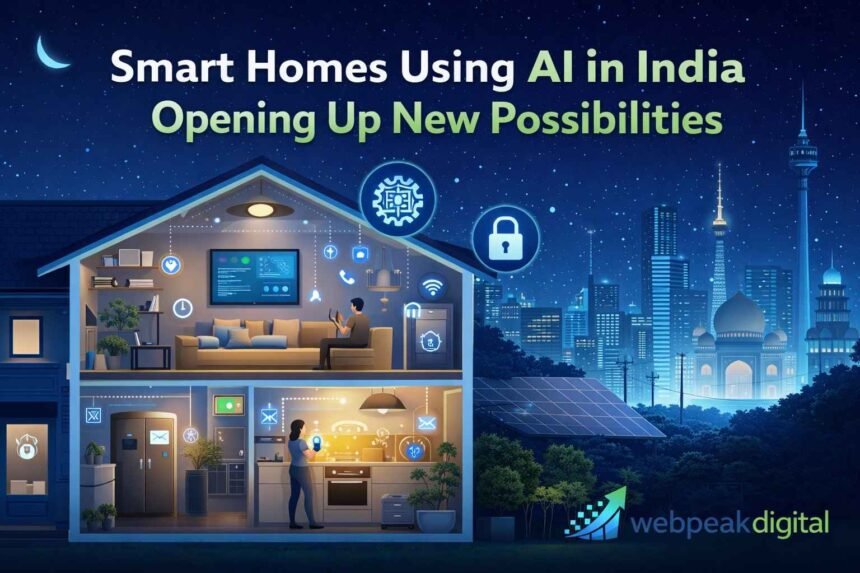
Smart homes using AI in India opening up new possibilities by changing how people manage energy, security, and daily living inside their homes. Instead of relying on fixed automation rules, AI-driven systems learn from real usage patterns and adjust automatically. This shift is happening quietly but steadily, driven by rising energy costs, urban lifestyles, and wider access to connected devices across Indian households.
What makes this change significant is not just convenience, but control and efficiency at scale. AI-powered homes are starting to respond to local conditions, user behavior, and infrastructure limits in a way traditional automation never could. For homeowners, developers, and policymakers, this marks a move from basic “smart features” to intelligent residential systems that can adapt, optimize, and improve over time.
What Are AI-Powered Smart Homes in the Indian Context
AI-powered smart homes in India are residential environments where artificial intelligence actively learns, predicts, and adapts home operations based on user behavior, local conditions, and system data.
Definition of AI-Driven Smart Home Systems
AI-driven smart home systems are home automation setups that use machine learning and data analysis to make decisions without manual input.
-
Systems learn daily routines like sleep patterns and appliance usage
-
Decisions improve over time based on real usage data
-
Automation adjusts proactively, not just on fixed rules
These systems move beyond simple control to continuous optimization.
Difference Between Traditional Automation and AI-Based Homes
The core difference is intelligence, not connectivity.
-
Traditional automation follows preset rules
-
AI-based homes adapt when habits or conditions change
-
AI can predict actions before users request them
This shift reduces manual configuration and improves long-term efficiency.
Why India Is a Unique Market for AI Smart Homes
India’s mix of infrastructure challenges and rapid digital adoption makes AI-driven homes especially relevant.
-
High energy cost sensitivity drives automation value
-
Diverse climates require adaptive systems
-
Multilingual households benefit from AI-driven voice interfaces
Local conditions increase the payoff from intelligent systems.
How AI Smart Home Systems Work End-to-End
AI smart home systems operate by collecting data, analyzing patterns, and executing decisions across connected devices in real time.
Role of AI, IoT, Sensors, and Connectivity
Each component plays a specific role in system intelligence.
-
Sensors capture motion, temperature, light, and usage
-
IoT devices transmit data across the network
-
AI models interpret patterns and trigger actions
Stable connectivity enables consistent system learning.
Data Collection, Learning, and Decision-Making
AI systems continuously improve through feedback loops.
-
Usage data is collected across devices
-
Machine learning identifies behavioral patterns
-
Decisions update automatically as conditions change
This allows systems to improve without reprogramming.
Integration With Mobile Apps and Voice Assistants
User interaction remains simple despite complex backend processing.
-
Mobile apps provide dashboards and overrides
-
Voice assistants enable hands-free control
-
AI prioritizes frequent commands automatically
The interface stays intuitive while intelligence runs silently.
Core Components of an AI-Enabled Smart Home
AI-enabled smart homes rely on coordinated hardware and software layers working together.
AI-Powered Devices and Controllers
Controllers act as the decision hub of the home.
-
Smart thermostats, lighting systems, and cameras
-
Central hubs coordinate multiple device types
-
Embedded AI enables local decision-making
Device quality directly impacts system reliability.
Cloud vs Edge AI in Home Automation
Processing location affects performance and privacy.
-
Cloud AI handles large-scale data analysis
-
Edge AI processes data locally for faster response
-
Hybrid models balance speed and learning depth
Edge processing reduces latency and data exposure.
Interoperability Across Smart Home Ecosystems
Compatibility determines long-term usability.
-
Open standards reduce vendor dependency
-
Cross-brand integration improves scalability
-
Poor interoperability increases upgrade costs
Ecosystem choice matters as much as device choice.
Why AI Smart Homes Are Gaining Momentum in India
AI smart homes are expanding due to economic, technological, and policy-driven factors.
Urbanization, Energy Costs, and Lifestyle Shifts
Urban households face increasing efficiency pressure.
-
Rising electricity costs encourage optimization
-
Smaller living spaces need better resource control
-
Work-from-home trends increase daily energy use
AI addresses these pressures automatically.
Smartphone and Internet Penetration
Smartphone adoption enables system access and control.
-
Mobile-first behavior aligns with app-based systems
-
Affordable broadband supports connected devices
-
Users are comfortable managing digital services
This lowers adoption friction significantly.
Government Push for Smart Cities and Digital India
Public initiatives indirectly support smart home adoption.
-
Smart infrastructure improves connectivity reliability
-
Digital literacy programs increase user readiness
-
IoT standards gain institutional support
Policy alignment reduces long-term adoption risk.
Key Benefits of AI Smart Homes for Indian Homeowners
AI smart homes deliver measurable improvements in cost control, safety, and comfort.
Energy Efficiency and Cost Optimization
AI reduces waste by adjusting usage automatically.
-
Appliances operate only when needed
-
Peak load usage is minimized
-
Long-term savings offset setup costs
Efficiency gains grow over time as learning improves.
Enhanced Home Security and Safety
Security systems become proactive instead of reactive.
-
Unusual patterns trigger alerts
-
Cameras learn familiar faces and routines
-
Emergency responses activate faster
AI reduces false alarms while improving coverage.
Personalized Comfort and Convenience
Homes adjust to occupants without manual input.
-
Lighting adapts to time and activity
-
Climate control follows personal preferences
-
Routine tasks run in the background
Comfort improves without increasing effort.
Benefits for Builders, Developers, and Real Estate Stakeholders
AI smart homes create operational and market advantages for property stakeholders.
Increased Property Value and Differentiation
Smart capabilities influence buyer perception.
-
Premium features justify higher pricing
-
Smart readiness signals future-proof design
-
Projects stand out in competitive markets
Technology becomes a value differentiator.
Operational Efficiency in Residential Projects
Developers gain better system oversight.
-
Central monitoring reduces maintenance overhead
-
Predictive alerts prevent major failures
-
Energy analytics improve common-area management
Operational costs decline over project lifecycles.
Demand From Tech-Savvy Buyers
Buyer expectations are shifting.
-
Younger buyers expect smart features
-
Rental markets favor connected properties
-
Long-term demand favors adaptable infrastructure
Smart readiness improves asset longevity.
Real-World Use Cases of AI Smart Homes in India
AI smart homes already support practical, everyday scenarios.
Intelligent Energy and Power Management
Energy systems respond dynamically.
-
Load balancing across appliances
-
Automatic shutdown of idle systems
-
Integration with time-based tariffs
This reduces monthly bills consistently.
AI-Driven Surveillance and Access Control
Security adapts to household behavior.
-
Entry systems recognize authorized users
-
Alerts trigger on abnormal movement
-
Remote access enables real-time control
Security improves without constant monitoring.
Predictive Maintenance and Automation
AI anticipates failures before disruption.
-
Appliance health monitoring
-
Early alerts for system degradation
-
Maintenance scheduled proactively
This prevents costly emergency repairs.
Best Practices for Implementing AI Smart Homes
Effective implementation depends on planning, security, and local relevance.
Choosing Scalable and Future-Ready Systems
Scalability protects long-term investment.
-
Modular systems allow gradual upgrades
-
Software-driven features extend lifespan
-
Avoid hard-coded, closed platforms
Flexibility reduces replacement costs.
Prioritizing Data Privacy and Security
Security must be built in from the start.
-
Strong authentication controls
-
Encrypted data transmission
-
Regular software updates
Neglecting security increases long-term risk.
Designing for Local Usage and Language Preferences
Local relevance improves adoption.
-
Support for regional languages
-
Adaptation to power reliability conditions
-
Offline fallback for critical systems
Design choices should reflect local realities.
Legal, Data Privacy, and Compliance Considerations
AI smart homes must operate within evolving regulatory frameworks.
Data Protection and User Consent
User data must be handled responsibly.
-
Clear consent mechanisms
-
Transparent data usage policies
-
Limited data retention practices
Trust depends on data governance.
Cybersecurity Risks in Connected Homes
Connected systems expand attack surfaces.
-
Weak passwords expose devices
-
Unpatched firmware creates vulnerabilities
-
Network segmentation reduces risk
Security planning must be continuous.
H3. Emerging Regulations Affecting AI and IoT in India
Regulatory oversight is increasing.
-
Data protection laws impact storage practices
-
IoT standards affect device certification
-
AI governance frameworks are evolving
Compliance planning should anticipate change.
Common Challenges and Risks in AI Smart Home Adoption
Adoption risks stem from cost, compatibility, and infrastructure constraints.
High Initial Costs and ROI Concerns
Upfront investment remains a barrier.
-
Premium devices raise entry costs
-
ROI varies based on usage patterns
-
Long-term savings require patience
Cost-benefit analysis is essential.
Compatibility and Vendor Lock-In
Poor ecosystem choices create dependency.
-
Proprietary systems limit flexibility
-
Switching costs increase over time
-
Updates may depend on vendor policies
Open systems reduce long-term risk.
Reliability and Connectivity Issues
System performance depends on infrastructure.
-
Internet outages disrupt cloud-based features
-
Power fluctuations affect device stability
-
Redundancy planning is often overlooked
Local resilience improves reliability.
Tools, Platforms, and Technologies Powering AI Smart Homes
AI smart homes rely on layered technology stacks.
AI Assistants and Smart Home Operating Systems
Operating systems coordinate device behavior.
-
Voice assistants enable natural interaction
-
Central platforms manage automation logic
-
Updates improve intelligence over time
The OS defines system capability.
Analytics and Automation Engines
Analytics drive continuous optimization.
-
Pattern detection across usage data
-
Automated rule refinement
-
Performance monitoring dashboards
Data insights improve system decisions.
Integration With Renewable Energy and EVs
AI enables energy ecosystem coordination.
-
Solar generation forecasting
-
EV charging optimization
-
Load balancing across sources
This supports future energy transitions.
AI Smart Homes vs Traditional Home Automation
AI smart homes differ fundamentally from rule-based automation systems.
Intelligence and Learning Capabilities Compared
Learning capability defines the gap.
-
Traditional systems follow static rules
-
AI systems evolve with usage
-
Adaptation reduces manual adjustments
Intelligence compounds over time.
Long-Term Cost and Efficiency Differences
Cost structures diverge long-term.
-
Automation saves labor but not energy
-
AI reduces waste and inefficiency
-
Maintenance costs trend lower
Efficiency improves year over year.
User Experience and Adaptability
User experience becomes less intrusive.
-
Fewer manual controls needed
-
Systems anticipate needs
-
Errors reduce as learning improves
Ease of use improves retention.
Practical Checklist for Adopting AI Smart Homes in India
Successful adoption follows a structured approach.
Assessing Home Readiness and Infrastructure
Readiness determines system performance.
-
Electrical wiring quality
-
Internet stability and coverage
-
Physical layout constraints
Baseline assessment prevents rework.
Selecting the Right Devices and Ecosystem
Ecosystem choice shapes future flexibility.
-
Compatibility with open standards
-
Vendor support track record
-
Update and maintenance policies
Decisions should favor longevity.
Planning for Maintenance and Future Upgrades
Maintenance planning protects investment.
-
Scheduled software updates
-
Device replacement planning
-
Support access arrangements
Long-term planning reduces disruption.
Frequently Asked Questions
What are smart homes using AI in India opening up new possibilities for?
Smart homes using AI in India are opening up new possibilities mainly around energy efficiency, security, and adaptive living. These systems learn user behavior, adjust to local conditions like power availability, and reduce manual effort. Over time, they help households lower costs and manage homes more efficiently without constant user input.
How are AI smart homes different from regular smart homes?
AI smart homes can learn and make decisions on their own, while regular smart homes follow fixed rules set by the user. For example, AI can predict when to switch off appliances or adjust cooling based on habits, whereas traditional systems need manual scheduling.
Are AI-powered smart homes practical for average Indian households?
Yes, but practicality depends on budget, connectivity, and use case. Many households start with limited AI features like smart lighting or security and expand gradually. Phased adoption makes AI smart homes more accessible and manageable over time.