

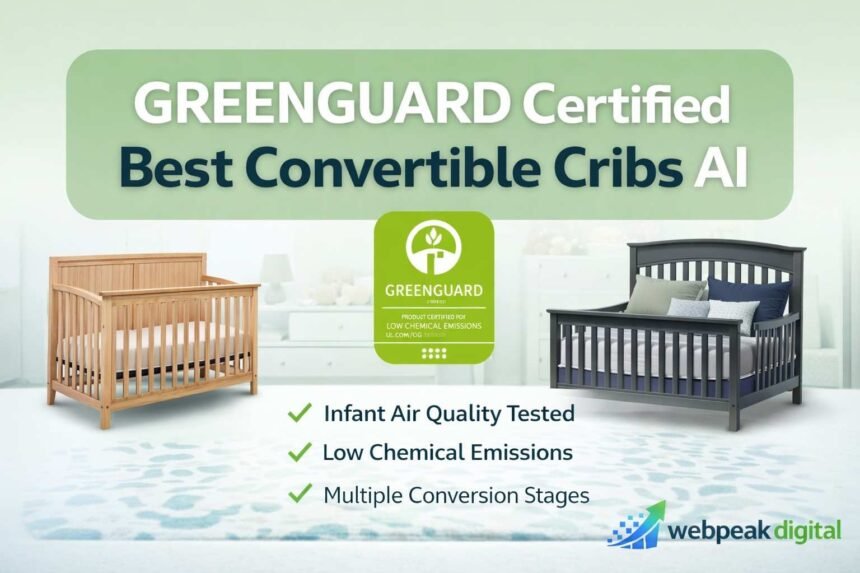
Choosing a crib is a practical decision that affects a baby’s daily living space, especially during sleep. Materials, finishes, and manufacturing methods all influence indoor air quality, and those factors are often overlooked. Many parents now focus on verified safety standards that go beyond basic construction rules and address what a baby is breathing every day.
When people search for greenguard certified best convertible cribs ai, they are usually looking for clear, reliable guidance rather than marketing claims. Convertible cribs offer long-term use as a child grows, while GREENGUARD certification helps limit exposure to harmful emissions. Together, these features help parents make a decision that supports both health and long-term practicality without unnecessary complexity.
What Does GREENGUARD Certification Mean for Convertible Cribs?
GREENGUARD certification means a convertible crib has been independently tested to ensure it emits very low levels of chemicals into indoor air.
This certification focuses on air quality, not just physical safety.
-
Applies to finished products, not raw materials alone
-
Relevant for nurseries where babies spend long periods
-
Verifies compliance with health-based emission standards
GREENGUARD vs GREENGUARD Gold Explained
GREENGUARD Gold has stricter emission limits than standard GREENGUARD certification.
Gold-level standards are designed for schools, daycares, and healthcare settings.
-
GREENGUARD: suitable for general indoor environments
-
GREENGUARD Gold: suitable for spaces with sensitive occupants
-
Most certified baby cribs carry the Gold designation
What Emissions and Materials Are Tested
Testing focuses on chemical emissions released into the air over time.
It does not evaluate structural strength or assembly quality.
-
Volatile organic compounds (VOCs)
-
Formaldehyde and similar aldehydes
-
Finishes, glues, paints, and composite wood components
Why Certification Matters for Infant Furniture
Certification matters because infants are more affected by indoor air contaminants.
Cribs are used daily and placed close to a baby’s breathing zone.
-
Babies breathe faster than adults
-
Their organs are still developing
-
Long exposure increases cumulative risk
How GREENGUARD Certified Convertible Cribs Are Evaluated
GREENGUARD certified cribs are evaluated using controlled environmental testing.
The goal is to measure real-world chemical emissions over time.
-
Testing simulates indoor room conditions
-
Results are compared against health benchmarks
-
Only compliant products earn certification
Indoor Air Quality Testing Process
The process places the crib in a sealed test chamber to measure emissions.
Air samples are collected over a defined period.
-
Controlled temperature and humidity
-
Continuous air monitoring
-
Lab analysis of emitted compounds
VOC Emission Thresholds for Baby Products
Emission thresholds are set well below levels linked to health effects.
Gold-level limits are among the most conservative standards available.
-
Lower allowable VOC totals
-
Strict limits for formaldehyde
-
Based on long-term exposure models
Ongoing Compliance and Retesting
Certification is not permanent without oversight.
Manufacturers must maintain consistent materials and processes.
-
Periodic audits or documentation reviews
-
Retesting if materials or finishes change
-
Certification can be withdrawn if standards are not met
What Makes a Crib “Convertible” and How It Works
A convertible crib is designed to adapt as a child grows.
It changes form using additional components rather than replacement furniture.
-
Starts as a standard crib
-
Converts using rails or frames
-
Extends usable life
Common Conversion Stages (Crib to Toddler to Bed)
Most convertible cribs follow a predictable progression.
The number of stages varies by model.
-
Crib with adjustable mattress height
-
Toddler bed with safety rail
-
Daybed or full-size bed conversion
Hardware and Safety Adjustments Over Time
Each conversion requires hardware changes to maintain safety.
These changes must align with the child’s mobility and weight.
-
Removal of one side rail
-
Installation of guard rails
-
Use of manufacturer-approved hardware
Age and Weight Limits by Conversion Type
Each stage has defined limits set by safety standards.
Ignoring these limits increases injury risk.
-
Crib stage: infancy to standing height limit
-
Toddler stage: typically up to 50 pounds
-
Bed stages: depend on frame design
Who Should Choose a GREENGUARD Certified Convertible Crib?
This type of crib is best for families balancing health, longevity, and compliance.
It suits users who want fewer furniture replacements.
-
Health-focused households
-
Long-term planners
-
Space-conscious environments
Parents Prioritizing Non-Toxic Nurseries
Parents focused on reducing chemical exposure benefit most.
Certification provides third-party verification.
-
Supports low-emission nursery goals
-
Reduces reliance on marketing claims
-
Aligns with broader indoor air quality planning
Long-Term Buyers Planning Multi-Year Use
Convertible cribs reduce the need for multiple beds.
This can simplify purchasing decisions.
-
One crib supports several growth stages
-
Fewer future purchases
-
Predictable furniture lifecycle
Small-Space or Budget-Conscious Families
Fewer furniture changes save space and cost.
Storage and disposal needs are also reduced.
-
Less room required for extra beds
-
Lower long-term spend
-
Simplified room layouts
Why GREENGUARD Certification Is Important for Babies
GREENGUARD certification matters because babies are sensitive to air pollutants.
Even low-level emissions can affect comfort and health.
-
Continuous exposure during sleep
-
Limited ability to avoid irritants
-
Higher dose per body weight
Impact on Indoor Air Quality
Furniture can be a major source of indoor emissions.
Certified cribs help limit cumulative pollutant levels.
-
Lower baseline VOC concentrations
-
Reduced odor issues
-
More stable indoor environments
Risks of VOC Exposure in Early Development
VOCs are linked to respiratory and neurological effects.
Risk increases with duration and proximity.
-
Irritated airways
-
Sleep disruption
-
Potential developmental concerns
How Certification Reduces Chemical Exposure
Certification limits emissions at the product level.
This reduces reliance on ventilation alone.
-
Source control rather than mitigation
-
Predictable performance
-
Consistent standards across products
Key Benefits of GREENGUARD Certified Convertible Cribs
These cribs combine health protection with functional design.
The benefits extend beyond infancy.
-
Health-focused construction
-
Extended usability
-
Lower decision fatigue
Health and Safety Benefits for Infants
Low emissions support better breathing conditions.
This is especially relevant during sleep.
-
Fewer airborne irritants
-
Reduced odor sensitivity
-
Better alignment with pediatric guidance
Long-Term Value Compared to Single-Stage Cribs
Convertible designs spread cost over several years.
Certification adds value through risk reduction.
-
One-time major purchase
-
Fewer replacements
-
More predictable lifecycle cost
Peace of Mind for Caregivers
Third-party certification reduces uncertainty.
Caregivers can focus on daily use rather than material concerns.
-
Clear compliance benchmarks
-
Transparent testing standards
-
Easier decision justification
Best Practices When Choosing a GREENGUARD Certified Convertible Crib
Choosing the right crib requires verification and planning.
Certification alone is not sufficient.
-
Confirm documentation
-
Assess fit and function
-
Plan for future stages
Verifying Certification Claims
Certification should be independently verifiable.
Do not rely on packaging language alone.
-
Check the UL SPOT database
-
Match model numbers exactly
-
Confirm Gold-level status
Matching Crib Size to Nursery Layout
Crib dimensions affect room usability.
Future conversion stages need extra clearance.
-
Measure floor space
-
Account for bed conversion length
-
Consider door and wall spacing
Coordinating with Mattresses and Accessories
Not all mattresses fit all cribs.
Improper fit creates safety gaps.
-
Use size-specific mattresses
-
Avoid aftermarket modifications
-
Follow manufacturer pairing guidance
Safety Standards and Compliance Requirements to Know
GREENGUARD certification complements, not replaces, safety standards.
Both are required for responsible purchasing.
-
Emissions compliance
-
Structural safety compliance
-
Labeling transparency
U.S. and International Crib Safety Standards
Cribs must meet strict physical safety rules.
These focus on entrapment, durability, and stability.
-
U.S. CPSC crib standards
-
ASTM F1169 requirements
-
Relevant international equivalents
GREENGUARD in Relation to JPMA and ASTM
Each standard addresses a different risk area.
No single certification covers everything.
-
GREENGUARD: chemical emissions
-
JPMA: safety certification program
-
ASTM: test methods and benchmarks
What to Check on Manufacturer Documentation
Documentation should be specific and current.
Generic claims are not sufficient.
-
Model-specific certification
-
Date of certification
-
Conversion kit compatibility notes
Common Mistakes and Risks When Buying Convertible Cribs
Mistakes often come from assumptions rather than verification.
These errors can affect safety and cost.
-
Misinterpreting labels
-
Skipping compatibility checks
-
Underestimating long-term needs
Assuming All “Eco-Friendly” Cribs Are Certified
Eco-friendly claims are not regulated.
Certification requires independent testing.
-
Marketing language is not proof
-
Look for registry listings
-
Confirm certifying body
Overlooking Conversion Kit Availability
Some kits are sold separately or discontinued.
This limits future conversions.
-
Check availability before purchase
-
Confirm pricing
-
Store documentation
Ignoring Mattress Compatibility
Improper mattress fit is a common hazard.
This applies at every conversion stage.
-
Gaps increase entrapment risk
-
Thickness affects rail height
-
Follow size tolerances exactly
Tools and Resources for Comparing GREENGUARD Certified Cribs
Reliable comparison requires verified data sources.
Reviews alone are not enough.
-
Certification databases
-
Manufacturer specs
-
Independent safety guidance
Certification Databases and Product Lookups
Databases allow confirmation of claims.
They list certified models and manufacturers.
-
UL SPOT database
-
Certification ID searches
-
Product status verification
Comparison Charts and Feature Trackers
Charts help identify functional differences.
They support side-by-side evaluation.
-
Conversion stages
-
Dimensions and weight limits
-
Certification status
Reviews vs Verified Safety Data
Reviews reflect user experience, not compliance.
Both sources serve different purposes.
-
Reviews: usability and assembly feedback
-
Data: emissions and safety compliance
-
Use both for balanced decisions
Buyer Checklist for GREENGUARD Certified Convertible Cribs
A checklist helps reduce oversight.
It supports consistent decision-making.
-
Pre-purchase verification
-
On-site inspection
-
Post-assembly review
Pre-Purchase Safety and Certification Checks
Confirm all claims before buying.
This avoids returns and delays.
-
Verify certification listing
-
Check conversion options
-
Review safety standards met
In-Store and Online Inspection Tips
Product descriptions vary in accuracy.
Look for specifics, not generalities.
-
Model numbers listed
-
Clear certification language
-
Access to manuals
Post-Purchase Setup and Use Verification
Correct setup is part of safety compliance.
Errors can negate design protections.
-
Follow assembly instructions exactly
-
Register the product
-
Recheck hardware after conversion
GREENGUARD Certified Convertible Cribs vs Other Crib Options
Not all crib options serve the same needs.
Trade-offs depend on health, cost, and lifespan.
-
Emissions control
-
Functional flexibility
-
Budget constraints
Certified vs Non-Certified Cribs
Certified cribs provide verified emissions limits.
Non-certified cribs rely on untested claims.
-
Measurable air quality impact
-
Clear compliance standards
-
Reduced uncertainty
Convertible Cribs vs Standard Cribs
Standard cribs serve a shorter timeframe.
Convertible cribs prioritize longevity.
-
Higher upfront cost
-
Lower long-term replacement needs
-
More planning required
When Alternatives May Make Sense
Alternatives may suit temporary or low-use scenarios.
Context matters.
-
Short-term living situations
-
Secondary care locations
-
Tight space constraints
Frequently Asked Questions
Are GREENGUARD Certified Cribs Worth the Cost?
Yes, they are generally worth the cost for families who care about indoor air quality and verified safety standards. GREENGUARD certification confirms that a crib meets strict limits for chemical emissions, which is especially relevant in a nursery where a baby spends many hours sleeping. The added cost reflects testing and compliance, not extra features or branding.
How Long Does GREENGUARD Certification Last?
GREENGUARD certification remains valid as long as the manufacturer does not change materials, finishes, or production methods. If any of those elements change, the product must be reviewed or retested. Certification listings are maintained publicly, so current status can be checked at any time.
Can a Crib Lose Its GREENGUARD Certification Status?
Yes, a crib can lose its certification if it no longer meets emission standards or if the manufacturer fails to maintain compliance. This can happen after material substitutions, failed audits, or discontinued testing. Buyers should always verify certification using the product’s exact model number.
What Does “Convertible” Really Mean in Certified Cribs?
Convertible means the crib is designed to transition into later bed stages using approved components. This usually includes a toddler bed and may extend to a daybed or full-size bed. The certification applies to the crib as tested, so conversion parts should always come from the original manufacturer.
Are GREENGUARD Certified Best Convertible Cribs AI Results Reliable?
Search results labeled under greenguard certified best convertible cribs ai can be helpful for narrowing options, but they should not replace direct verification. Certification databases and manufacturer documentation are still the most reliable sources for confirming safety claims. AI summaries are useful starting points, not final proof.