

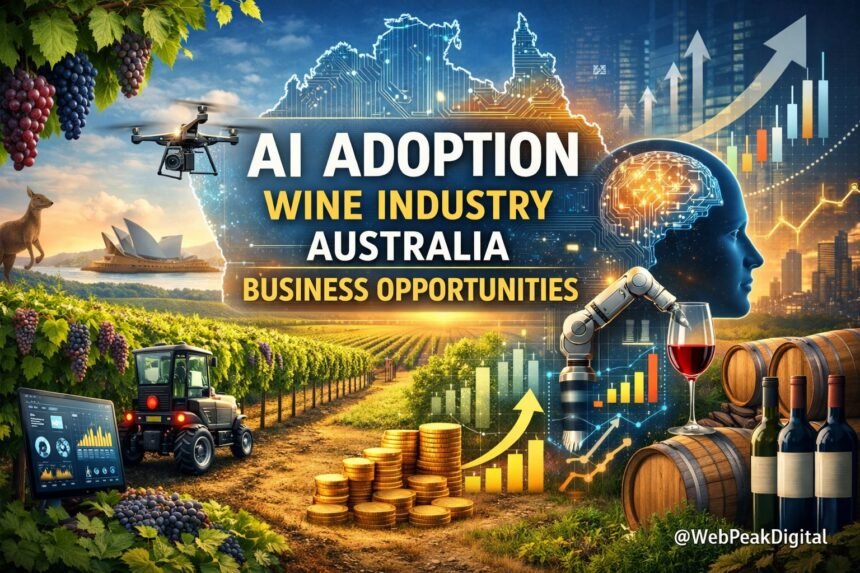
The Australian wine sector is under growing pressure from climate volatility, labour constraints, and tighter margins, pushing producers to rethink how decisions are made across vineyards, production, and distribution. Data-driven systems are increasingly used to support forecasting, quality control, and operational planning, helping businesses respond faster and with more precision than traditional methods allow.
Within this context, ai adoption wine industry australia business opportunities has become a practical discussion rather than a theoretical one. Producers, technology providers, and investors are assessing where AI can create measurable value, whether through yield stability, cost control, export readiness, or new service models, while still fitting the regulatory, operational, and cultural realities of the Australian wine landscape.
What AI Adoption Means for the Australian Wine Industry
Definition of AI adoption in viticulture and winemaking
AI adoption in viticulture and winemaking means using data-driven systems to support or automate decisions across grape growing, production, and business operations.
It focuses on prediction, optimisation, and pattern recognition rather than replacing human expertise.
In practice, this includes:
- Algorithms analysing weather, soil, and vine data
- Systems predicting yield, quality, or disease risk
- Software supporting production planning and commercial decisions
Scope of AI across vineyards, wineries, and distribution
AI applies across the full wine value chain, not just in the vineyard.
Its scope extends from farm-level decisions to global sales operations.
Key areas include:
- Vine health monitoring and harvest timing
- Fermentation control and quality consistency
- Demand forecasting, pricing, and logistics coordination
How Australia compares to global wine markets
Australia sits in the early-to-mid adoption phase compared with leading wine regions.
Adoption is stronger among large producers than across the full industry.
Relative positioning shows:
- Strong research capability and pilot programs
- Slower commercial rollout than parts of the US and EU
- Higher openness to automation due to labour constraints
Current State of AI Adoption in Australian Wine Businesses
Adoption levels among large producers vs small wineries
AI use is currently uneven across the industry.
Large producers adopt AI faster due to scale, data access, and capital.
Typical differences include:
- Large producers using enterprise analytics and forecasting tools
- Small wineries relying on limited, off-the-shelf solutions
- Mid-sized firms experimenting through pilots rather than full deployment
Key regions leading AI-driven wine innovation
AI experimentation clusters in regions with strong infrastructure and research ties.
These areas combine advanced viticulture with digital capability.
Leading regions often feature:
- Proximity to universities and agri-research centres
- Larger corporate vineyards and export-focused producers
- Better access to connectivity and sensor infrastructure
Role of industry bodies and research institutions
Industry organisations act as catalysts rather than operators.
They reduce adoption risk through research, trials, and shared knowledge.
Their role includes:
- Funding applied research and field trials
- Publishing best-practice guidance
- Supporting skills development and technology transfer
How AI Is Used Across the Wine Value Chain
AI applications in vineyard monitoring and crop management
AI supports earlier and more precise vineyard decisions.
It works by converting environmental data into actionable insights.
Common applications include:
- Disease and pest risk prediction
- Irrigation and nutrient optimisation
- Yield estimation and harvest scheduling
AI in wine production, quality control, and blending
AI improves consistency and efficiency during production.
It assists winemakers by analysing patterns humans cannot track at scale.
Typical uses involve:
- Fermentation monitoring and anomaly detection
- Batch quality classification
- Blend optimisation based on historical outcomes
AI-driven logistics, inventory, and supply chain planning
AI improves alignment between production and market demand.
It reduces waste, stockouts, and working capital pressure.
Operational benefits include:
- More accurate demand forecasting
- Inventory optimisation across channels
- Transport and distribution planning
Business Opportunities Created by AI in the Wine Industry
Revenue growth opportunities for wineries
AI enables revenue growth through better decisions, not higher volume alone.
It helps producers align supply, pricing, and product mix with demand.
Revenue impacts come from:
- Improved yield predictability
- Reduced quality variance
- Smarter pricing and channel allocation
New markets for agritech and AI solution providers
The wine sector creates demand for specialised AI solutions.
Generic tools often fail without industry-specific adaptation.
Opportunities exist for providers offering:
- Vineyard-focused analytics platforms
- Wine-specific forecasting and optimisation tools
- Integration services tailored to winery operations
Investment and partnership opportunities in wine technology
AI adoption opens collaboration opportunities rather than standalone buying.
Many wineries prefer partnerships over in-house development.
Common models include:
- Joint pilots with technology firms
- Licensing of proven platforms
- Research-backed commercial trials
Why AI Adoption Matters for Australia’s Wine Competitiveness
Addressing labour shortages and rising production costs
AI helps offset structural labour constraints.
It reduces reliance on manual monitoring and reactive decision-making.
Cost pressures are addressed through:
- Automation of repetitive tasks
- Better resource allocation
- Reduced rework and loss
Managing climate variability and sustainability pressures
AI improves resilience to climate uncertainty.
It supports proactive rather than reactive vineyard management.
Sustainability benefits include:
- Reduced water and chemical use
- Earlier detection of climate stress
- Data-backed environmental reporting
Strengthening export performance and global positioning
AI supports consistency at scale, which matters for export markets.
It helps maintain quality across seasons and regions.
Export advantages include:
- Predictable supply for overseas buyers
- Stronger compliance documentation
- Improved market intelligence
Benefits of AI Adoption for Different Stakeholders
Benefits for vineyard owners and growers
AI improves decision confidence at the vineyard level.
It reduces guesswork and late intervention.
Key benefits include:
- Earlier risk detection
- More efficient input use
- Clearer yield expectations
Benefits for wine producers and brand owners
Producers gain operational and commercial clarity.
AI supports repeatability without removing creative control.
Benefits typically include:
- More stable production outcomes
- Better portfolio management
- Faster response to market shifts
Benefits for distributors, retailers, and exporters
Downstream partners benefit from predictability and data transparency.
AI improves coordination across the supply chain.
Advantages include:
- Improved demand planning
- Reduced supply volatility
- Better customer fulfilment
Best Practices for Implementing AI in Wine Businesses
Aligning AI strategy with business objectives
AI works best when tied to clear operational goals.
Technology should follow the problem, not lead it.
Best practice involves:
- Defining priority use cases
- Linking AI outputs to decisions
- Setting measurable success criteria
Data readiness and infrastructure considerations
AI depends on reliable data.
Poor data quality limits outcomes regardless of tool sophistication.
Core requirements include:
- Consistent data collection
- Integration across systems
- Clear data ownership
Building internal skills and external partnerships
Successful adoption blends internal knowledge with external expertise.
Few wineries benefit from going it alone.
Effective approaches include:
- Upskilling key staff
- Partnering with specialists
- Starting with small, controlled deployments
Regulatory, Data, and Compliance Considerations in Australia
Data privacy and ownership issues in AI systems
AI systems rely on sensitive operational data.
Ownership and access must be clearly defined.
Key considerations include:
- Data sharing agreements
- Vendor access controls
- Long-term data retention rules
Industry standards and regulatory expectations
AI use must align with existing agricultural and consumer regulations.
Compliance expectations are increasing, not decreasing.
Relevant areas include:
- Food safety standards
- Traceability requirements
- Consumer transparency obligations
Ethical and transparency considerations in AI use
AI decisions must remain explainable.
Opaque systems create trust and compliance risks.
Good practice involves:
- Human oversight of key decisions
- Documented model logic
- Clear accountability structures
Common Challenges, Risks, and Barriers to AI Adoption
Cost, ROI uncertainty, and technology complexity
AI investments carry upfront cost and delayed returns.
Unclear value cases slow adoption.
Common issues include:
- Overestimating short-term benefits
- Underestimating integration effort
- Choosing overly complex solutions
Integration issues with legacy systems
Many wineries operate fragmented systems.
AI tools often struggle without integration planning.
Typical challenges involve:
- Disconnected data sources
- Manual data handling
- Limited system compatibility
Skills gaps and change management risks
AI changes how decisions are made.
Resistance often comes from process, not technology.
Risks include:
- Low user adoption
- Misinterpretation of outputs
- Loss of trust in systems
AI Tools and Technologies Used in the Wine Industry
Precision agriculture platforms and sensor technologies
These tools collect real-time vineyard data.
They form the foundation of most AI use cases.
Common components include:
- Soil and climate sensors
- Drone and satellite imagery
- Field data platforms
Predictive analytics and machine learning systems
These systems turn data into forecasts and recommendations.
They support planning rather than automation alone.
Typical uses involve:
- Yield prediction
- Quality classification
- Demand forecasting
Generative AI and decision-support tools
Generative systems support analysis and planning tasks.
They assist people rather than control processes.
Use cases include:
- Scenario modelling
- Reporting and insight summarisation
- Internal decision support
Actionable Checklist for Wine Businesses Exploring AI
Assessing readiness for AI adoption
Readiness depends on data, people, and objectives.
Not all businesses should start at the same point.
Key checks include:
- Data availability
- Operational clarity
- Leadership commitment
Identifying high-impact use cases
Early wins matter.
High-impact use cases are specific and measurable.
Focus areas often include:
- Yield forecasting
- Inventory planning
- Quality consistency
Measuring performance and long-term value
AI performance must be tracked over time.
Value often increases with use and refinement.
Measurement should cover:
- Financial impact
- Operational efficiency
- Decision quality
AI Adoption vs Traditional Approaches in Wine Production
Manual decision-making vs data-driven insights
Traditional methods rely on experience and observation.
AI adds scale and pattern recognition.
Key differences include:
- Speed of insight
- Consistency across seasons
- Ability to test scenarios
Cost efficiency and scalability comparison
Manual approaches struggle to scale.
AI systems improve marginal efficiency over time.
Scalability advantages include:
- Lower incremental cost
- Replicable processes
- Centralised oversight
Risk management and consistency outcomes
AI reduces variability but does not remove risk.
It supports earlier intervention.
Risk outcomes improve through:
- Predictive alerts
- Scenario planning
- Standardised decision logic
Frequently Asked Questions (FAQs)
What does ai adoption wine industry australia business opportunities actually mean?
It refers to how Australian wine businesses are using artificial intelligence to improve vineyard management, production efficiency, forecasting, and commercial decision-making, while also creating new opportunities for growth, partnerships, and investment.
Which areas of the wine industry benefit most from AI technologies?
Vineyard monitoring, yield prediction, quality control, supply chain planning, and demand forecasting tend to see the fastest and most measurable benefits from AI-based systems.
Are AI solutions practical for small and mid-sized Australian wineries?
Yes, when applied to specific use cases such as crop monitoring or inventory planning, AI tools can be cost-effective and scalable without requiring large enterprise budgets.
What are the main risks of adopting AI in wine production?
Common risks include poor data quality, unclear return on investment, integration challenges with existing systems, and limited internal expertise to interpret AI outputs correctly.
How will AI adoption shape the future of the Australian wine industry?
AI is expected to support greater resilience against climate variability, improve operational consistency, and help Australian wine businesses remain competitive in global export markets.