

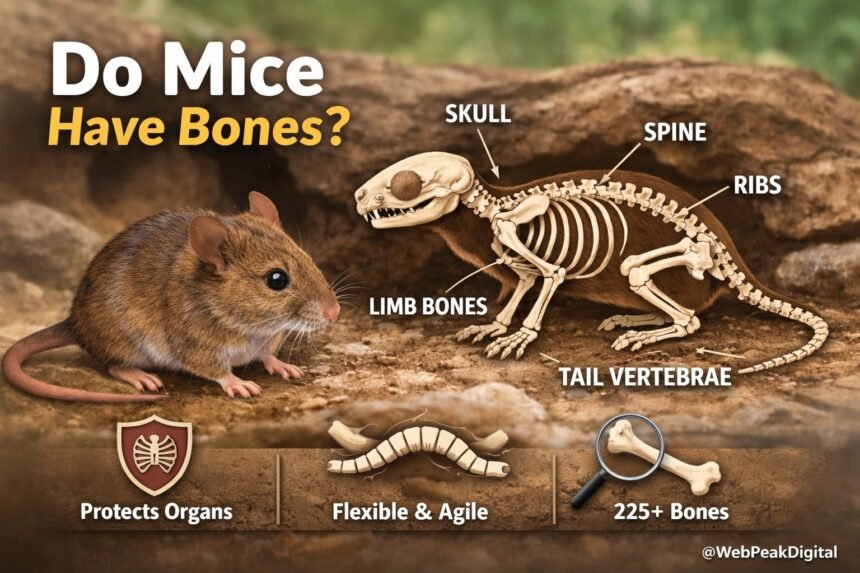
Mice are small mammals known for their agility, quick movements, and ability to navigate tight spaces. Their flexibility often makes people curious about their anatomy and how such tiny creatures can move so efficiently. Observing a mouse in motion highlights a body that is both delicate and highly adaptable, supported by a complex internal structure.
Many wonder if mice have a fully developed skeleton, or in other words, do mice have bones. The answer is yes, mice have a complete set of bones, including a skull, spine, ribs, limbs, and tail vertebrae. This skeletal system provides both support and mobility, allowing mice to climb, squeeze through narrow gaps, and perform other activities that require precision and flexibility.
Understanding Mice as Vertebrates
What Defines a Vertebrate Animal?
Vertebrates are animals with a backbone and an internal skeleton made of bones or cartilage.
- The backbone provides structural support and protects the spinal cord.
- Vertebrates have a head, spinal column, and internal organs supported by bones.
- Bones allow movement through jointed connections with muscles.
How Mice Fit into the Mammal Classification
Mice are mammals with a complete skeletal system.
- They have a backbone, skull, ribs, and limb bones.
- Mice possess characteristics of mammals: warm-blooded, fur-covered bodies, and live births.
- Their skeletal structure is fully developed to support movement, growth, and survival.
Do Mice Really Have Bones?
Debunking Common Myths About Mouse Skeletons
Yes, mice have bones; myths about “boneless” mice are false.
- Flexibility is often mistaken for a lack of bones.
- Bones are small and light, but structurally complete.
- The skeleton supports the body while allowing agility.
Key Features of a Mouse Skeleton
The mouse skeleton is compact yet fully functional.
- It consists of the skull, spine, ribcage, limbs, and tail vertebrae.
- Bones are arranged to provide support and mobility.
- The tail has multiple small vertebrae contributing to overall bone count.
Anatomy of a Mouse Skeleton
Major Bones: Skull, Spine, Limbs, and Tail
The skeleton has distinct regions with specific functions.
- Skull: Protects the brain and sensory organs.
- Spine: Supports the body and enables flexibility.
- Limbs: Forelimbs and hindlimbs allow climbing, running, and digging.
- Tail: Adds balance and flexibility in movement.
How the Tail Contributes to Overall Bone Count
The tail contains a series of small vertebrae.
- These vertebrae can number over 20, depending on the species.
- They increase total bone count while aiding agility.
- The tail allows balance, navigation, and grip in confined spaces.
Bone Structure Compared to Other Small Mammals
Mouse bones are similar to other rodents but more flexible in certain areas.
- The spine is more segmented for bending.
- Limb bones are proportional to body size for rapid movement.
- Small mammals like hamsters and rats have comparable skeletal layouts but vary in tail length and vertebrae count.
How Mouse Bones Support Flexibility
Joint Design and Spine Mobility
Mouse joints are designed for maximum flexibility.
- Vertebrae are closely spaced but allow significant bending.
- Limbs have ball-and-socket and hinge joints for climbing and digging.
- Spine flexibility helps mice squeeze through narrow openings.
The Role of Small and Mobile Clavicles
Mice have reduced collarbones that increase shoulder movement.
- This allows forelimbs to rotate more freely.
- Enhanced shoulder mobility aids in navigating tight spaces.
- Mobility does not mean bones are absent; they remain structurally intact.
Why Mice Can Squeeze Through Tiny Spaces
The head sets the limiting dimension for passage.
- Bones are small, light, and joints flexible.
- Muscles and spine adjust body shape without injuring bones.
- Tail vertebrae bend to assist movement in narrow gaps.
Skeletal Development and Growth
Bone Formation in Juvenile vs. Adult Mice
Mice are born with partially formed bones that ossify over time.
- Juvenile mice have cartilage-rich bones that harden with age.
- Adult bones are fully ossified for strength and durability.
- Growth plates allow bones to lengthen during development.
Factors That Affect Bone Health
Mouse bones can weaken or strengthen depending on conditions.
- Diet: Calcium and vitamin D are essential.
- Activity: Regular movement maintains bone density.
- Genetics: Some strains have naturally denser or more flexible bones.
Biological Functions of Bones in Mice
Protection of Organs and Structural Support
Bones form a protective framework for vital organs.
- Skull protects the brain and sensory organs.
- Ribs shield the heart and lungs.
- Spine supports internal organs and body shape.
Bone Marrow and Blood Production
Bones house marrow where blood cells are produced.
- Red marrow generates red and white blood cells.
- Marrow ensures proper immune function and oxygen transport.
Muscular Attachments and Movement
Bones provide anchor points for muscles.
- Muscles attach to bones via tendons.
- Movement is coordinated through bone leverage and joint flexibility.
- This allows climbing, running, and burrowing efficiently.
Comparing Mouse and Human Skeletons
Bone Count Differences and Similarities
Mice have roughly 225–231 bones, more than humans.
- Humans typically have 206 bones.
- Tail vertebrae in mice account for the higher count.
- Both species share the same basic skeletal components: skull, spine, ribs, and limbs.
Functional Implications of Flexibility Differences
Mouse bones are smaller, lighter, and more flexible than human bones.
- Human bones prioritize strength and weight-bearing.
- Mouse skeletal flexibility enables passage through small gaps.
- Both skeletons serve similar biological functions adapted to their size and lifestyle.
Common Misconceptions About Mouse Skeletons
“Do Mice Have Collapsible Bones?”
Mouse bones do not collapse; they are flexible at joints.
- Collapsibility is a myth arising from body flexibility.
- Bones remain intact under normal movement.
- Flexible joints allow safe navigation in confined spaces.
Debunking Myths Related to Mouse Size and Flexibility
Small size and bending ability do not mean a lack of bones.
- Mice can squeeze through holes smaller than their body width.
- The skeleton adjusts without damage.
- Tail and shoulder mobility enhance adaptability.
Tools and Techniques to Study Mouse Bones
Laboratory Imaging Methods (X-ray, CT Scans)
Imaging provides precise observation without dissection.
- X-rays show bone alignment and density.
- CT scans reveal three-dimensional bone structures.
- Imaging helps study flexibility, fractures, and development.
Dissection and Observation Techniques
Physical study of skeletons provides direct insights.
- Careful dissection exposes skull, limbs, and vertebrae.
- Observation reveals bone connections and joint mechanics.
- Used in research, anatomy studies, and educational settings.
Risks and Injuries Related to Mouse Bones
Bone Fractures and Common Skeletal Injuries
Mouse bones can fracture under trauma or poor handling.
- Limbs and tails are most vulnerable.
- Fractures affect mobility and survival.
- Injuries are studied in laboratory models for research purposes.
How Flexibility Protects Against Injury
Joint and spine flexibility reduce stress on bones.
- Vertebral bending distributes pressure safely.
- Shoulder mobility prevents fractures during climbing.
- Tail flexibility aids balance and reduces falls.
Actionable Facts for Observing Mice Safely
How to Identify Bones Without Harm
Bones can be observed using non-invasive methods.
- Use imaging or external palpation.
- Avoid excessive handling that stresses joints.
- Observe movement patterns to infer skeletal structure.
Tips for Handling and Studying Mice
Proper handling preserves bone health.
- Support body weight evenly when lifting.
- Avoid twisting limbs or tail.
- Use gentle restraint techniques in research settings.
Alternatives and Comparisons
How Other Rodents’ Skeletons Differ
Rodents share similar skeletal structures but vary in size and tail length.
- Rats have longer tails and slightly denser bones.
- Hamsters have shorter tails and compact skeletons.
- Flexibility varies by species and ecological adaptation.
Comparing Wild Mice vs. Lab Mice Skeletal Features
Lab mice may have subtle skeletal differences due to controlled breeding.
- Bone density can differ from wild counterparts.
- Tail and limb length may vary slightly.
- Flexibility remains sufficient for normal movement in both.
Frequently Asked Questions (FAQs)
Do mice have bones and how are they structured?
Yes, mice have bones. Their skeleton includes a skull, spine, ribs, limbs, and tail vertebrae. This structure provides support, protects organs, and allows for flexibility so mice can move, climb, and squeeze through tight spaces.
How many bones are there in a mouse’s body?
An adult mouse typically has around 225–231 bones. The tail contains multiple small vertebrae, which contribute significantly to the total bone count.
Why can mice fit through very small gaps?
Mice can squeeze through narrow spaces because of their flexible spine, mobile shoulder bones, and small overall size. The head is the limiting factor when passing through tight openings.
Can a mouse’s bones heal if they are broken?
Yes, mouse bones can heal through natural bone remodeling. Proper immobilization helps recovery, though severe fractures may permanently affect mobility.
How do mouse bones compare to human bones?
Mouse bones are smaller, lighter, and more flexible than human bones. Humans have about 206 bones, while mice have more due to their many tail vertebrae. The flexibility of mouse bones allows for agility that human bones cannot replicate.