

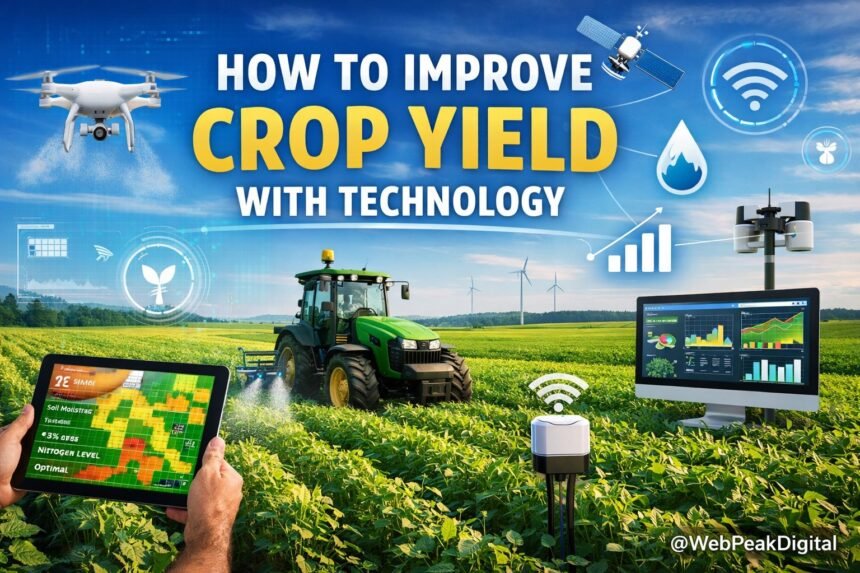
Improving crop productivity is no longer just about putting in more effort or expanding farmland. Today’s farms deal with unpredictable weather, uneven soil conditions, higher input costs, and tighter profit margins. Getting better results now depends on making the right decisions at the right time and using resources more carefully. As a result, farming practices have shifted toward accuracy, planning, and measurable outcomes rather than guesswork.
Discussions around how to improve crop yield with technology focus on using tools that actually help in day-to-day field operations. Precision equipment, data-based insights, automation, and monitoring systems make it easier to match water, nutrients, and treatments to what crops truly need. When used properly, these methods help farmers reduce waste, control risk, and achieve more stable yields without putting extra pressure on land or the environment.
What Crop Yield Means in Modern Agriculture
How crop yield is measured today
Crop yield is measured as the amount of harvested crop per unit of land over a specific period.
It is commonly calculated using weight or volume per hectare or acre.
- Physical output such as tons, kilograms, or bushels
- Adjusted for moisture content and crop type
- Compared across seasons to assess performance
- Used to benchmark farms, regions, and practices
Factors that limit yield in traditional farming
Traditional farming limits yield due to uniform decision-making and delayed responses.
Most losses come from inefficiencies rather than lack of effort.
- Uneven soil fertility across fields
- Over- or under-application of water and inputs
- Late detection of pests and diseases
- Dependence on manual observation
Why technology has become essential for yield growth
Technology is essential because modern yield gains require precision, speed, and scale.
Manual methods cannot manage today’s climate variability and input costs.
- Farms are larger and more complex
- Weather patterns are less predictable
- Input prices demand efficiency
- Data-driven decisions outperform intuition
How Agricultural Technology Improves Crop Yield
Data-driven decision making in farming
Agricultural technology improves yield by turning field data into actionable decisions.
Farmers rely on measurements rather than assumptions.
- Soil, weather, and crop data guide actions
- Decisions are based on real conditions
- Historical data improves future planning
- Risk is reduced through forecasting
Precision input application vs blanket methods
Precision input application applies resources only where needed.
Blanket methods treat entire fields the same, causing waste and stress.
- Fertilizer rates adjusted per soil zone
- Water applied based on moisture levels
- Chemicals used only in affected areas
- Crop health improves with fewer inputs
Real-time monitoring and early problem detection
Real-time monitoring identifies issues before yield loss occurs.
Early detection is one of the biggest yield advantages of technology.
- Sensors detect moisture and nutrient stress
- Imaging spots disease before visible symptoms
- Alerts trigger timely interventions
- Crop recovery chances increase significantly
Precision Agriculture and Its Role in Yield Improvement
GPS-based field mapping and variable rate technology
GPS mapping divides fields into management zones.
Variable rate technology adjusts inputs for each zone.
- Soil variability is mapped accurately
- Inputs match local field conditions
- Yield gaps are reduced
- Input efficiency improves
Soil and crop sensors for targeted interventions
Sensors provide continuous feedback from the field.
They replace guesswork with measurable indicators.
- Soil moisture sensors guide irrigation
- Nutrient sensors detect deficiencies
- Canopy sensors assess plant health
- Interventions become timely and precise
Yield mapping and performance analysis
Yield mapping records production differences across fields.
Performance analysis explains why those differences exist.
- Harvest data reveals high- and low-yield zones
- Management decisions are reviewed
- Inputs are adjusted for the next cycle
- Long-term productivity improves
Smart Irrigation and Water Management Technologies
Sensor-based irrigation scheduling
Sensor-based scheduling irrigates crops only when needed.
It prevents both water stress and overwatering.
- Soil moisture thresholds trigger irrigation
- Weather data adjusts watering plans
- Crop growth stages are considered
- Water use becomes predictable
Drip and micro-irrigation systems
Drip and micro-irrigation deliver water directly to roots.
They reduce evaporation and runoff losses.
- Water is applied slowly and evenly
- Nutrients can be delivered with water
- Weed growth is reduced
- Yield stability improves
Reducing water stress without lowering output
Water stress is reduced by timing and accuracy, not volume.
Technology balances crop demand with available supply.
- Critical growth stages are prioritized
- Stress signals are detected early
- Water efficiency improves without yield loss
- Crops maintain consistent growth
Using Drones and Remote Sensing for Crop Monitoring
Identifying crop stress, pests, and diseases early
Drones detect crop problems before they spread.
They reveal patterns invisible from ground level.
- Multispectral images show stress zones
- Pest damage is isolated early
- Disease outbreaks are localized
- Treatment becomes targeted
Aerial imaging for field-level insights
Aerial imaging provides a complete view of the field.
It supports better planning and evaluation.
- Plant vigor is mapped
- Stand gaps are identified
- Drainage issues become visible
- Decisions are based on field-wide data
Targeted spraying and treatment planning
Targeted spraying treats only affected areas.
This reduces chemical use and crop exposure.
- Spray zones are pre-mapped
- Application rates are adjusted
- Drift and waste are minimized
- Crop recovery improves
Artificial Intelligence and Data Analytics in Farming
AI-based yield prediction and forecasting
AI predicts yield by analyzing multiple data sources.
Forecasts help farmers plan inputs and harvest timing.
- Weather patterns are factored in
- Soil and crop data are combined
- Risk scenarios are evaluated
- Decision confidence increases
Machine learning for pest and disease management
Machine learning identifies pest and disease risks early.
Models improve as more data is collected.
- Historical outbreaks inform predictions
- Environmental triggers are monitored
- Treatment timing improves
- Crop losses are reduced
Decision support systems for farmers
Decision support systems convert data into clear actions.
They simplify complex information.
- Recommendations are prioritized
- Alerts highlight urgent issues
- Long-term trends are visible
- Farmers stay in control of decisions
Automation, Robotics, and Smart Machinery
Autonomous tractors and harvesting equipment
Autonomous machinery performs tasks with high consistency.
It reduces timing errors that affect yield.
- Operations run with precise alignment
- Field coverage improves
- Work continues in tight windows
- Harvest losses decrease
Robotic weeding and precision spraying
Robots remove weeds without harming crops.
Precision spraying targets individual plants.
- Chemical resistance risks drop
- Crop competition is reduced
- Input use becomes minimal
- Yield quality improves
Reducing labor dependency while increasing consistency
Automation reduces reliance on manual labor.
Consistency improves across large operations.
- Tasks are performed uniformly
- Labor shortages have less impact
- Timing remains accurate
- Operational reliability increases
Biotechnology and Improved Crop Varieties
High-yield and stress-resistant seed technologies
Improved seeds are designed for performance under stress.
They support stable yields in variable conditions.
- Drought and heat tolerance improves
- Disease resistance is built-in
- Nutrient efficiency increases
- Yield potential is higher
Role of genetic improvement in productivity
Genetic improvement enhances plant efficiency.
It allows crops to convert inputs into output more effectively.
- Photosynthesis efficiency improves
- Root systems are stronger
- Growth cycles are optimized
- Yield consistency increases
Technology-enabled breeding programs
Breeding programs use data and modeling tools.
Development cycles are faster and more accurate.
- Traits are tested digitally
- Field trials are optimized
- Variety selection improves
- Adoption risks decrease
Benefits of Technology-Driven Yield Improvement
Higher productivity per acre
Technology increases output from existing land.
It focuses on efficiency, not expansion.
- Yield gaps are reduced
- Marginal land performs better
- Production becomes predictable
- Food supply reliability improves
Lower input costs and resource efficiency
Efficiency lowers costs without sacrificing output.
Inputs are used only where they add value.
- Fertilizer waste declines
- Water use is controlled
- Fuel and labor costs drop
- Profit margins stabilize
Environmental and sustainability advantages
Technology supports sustainable farming practices.
Yield growth aligns with environmental protection.
- Runoff and leaching decrease
- Soil health is preserved
- Emissions are reduced
- Long-term land productivity improves
Best Practices for Implementing Farm Technology
Assessing farm readiness and infrastructure
Technology works best when infrastructure is prepared.
Assessment prevents costly missteps.
- Connectivity is evaluated
- Equipment compatibility is checked
- Data management capacity is reviewed
- Financial limits are defined
Choosing technology based on crop type and region
Not all tools suit every farm.
Selection should match local conditions.
- Climate and soil are considered
- Crop value justifies investment
- Scale of operation matters
- Support availability is reviewed
Training and skill development for farmers
Skills determine technology success.
Training ensures tools are used correctly.
- Operators understand system limits
- Data interpretation improves
- Errors decrease
- Adoption becomes sustainable
Common Challenges and Risks in Agri-Technology Adoption
High initial investment and ROI concerns
Upfront costs can delay adoption.
Returns depend on correct use and scale.
- Equipment costs are significant
- Benefits may take time
- Poor planning reduces returns
- Financing options matter
Data accuracy and system integration issues
Inaccurate data leads to poor decisions.
Integration issues limit system value.
- Sensors require calibration
- Platforms must communicate
- Data gaps reduce reliability
- Oversight remains necessary
Technology access in developing regions
Access remains uneven across regions.
Infrastructure and affordability are key barriers.
- Connectivity is limited
- Training resources are scarce
- Support services are inconsistent
- Adoption progresses unevenly
Essential Tools and Systems for Improving Crop Yield
Farm management software and platforms
Farm management software centralizes operations.
It connects planning, execution, and analysis.
- Input records are tracked
- Field activities are scheduled
- Performance is reviewed
- Compliance is documented
IoT devices and field sensors
IoT devices collect continuous field data.
They provide visibility across the season.
- Soil moisture is monitored
- Weather conditions are logged
- Crop status is tracked
- Alerts improve responsiveness
Analytics dashboards and monitoring tools
Dashboards turn raw data into insights.
They support daily and strategic decisions.
- Trends are visualized
- Anomalies are flagged
- Performance is compared
- Decisions are simplified
Actionable Checklist for Increasing Crop Yield With Technology
Planning and goal setting
Yield improvement starts with clear goals.
Planning aligns technology with outcomes.
- Define yield targets
- Identify constraints
- Set measurable benchmarks
- Allocate resources
Technology selection and deployment
Deployment should follow a structured approach.
Rushed adoption increases risk.
- Pilot before scaling
- Integrate with existing systems
- Train users early
- Validate data quality
Monitoring, optimization, and scaling
Continuous monitoring ensures long-term gains.
Optimization improves results over time.
- Review performance regularly
- Adjust inputs and settings
- Scale successful practices
- Retire ineffective tools
Frequently Asked Questions (FAQs)
How to improve crop yield with technology on small and medium farms?
Crop yield can be improved by using affordable tools like soil moisture sensors, mobile advisory apps, basic farm management software, and precision irrigation systems. These technologies help apply water, fertilizer, and treatments based on actual crop needs rather than estimates.
Which agricultural technology has the biggest impact on yield?
Precision irrigation and data-based nutrient management usually deliver the fastest and most noticeable yield improvements because they directly address water stress and nutrient imbalance, which are common yield-limiting factors.
Is advanced technology necessary for all types of crops?
Not all crops require advanced systems. High-value crops benefit most from precision tools, while staple crops can see improvements using simpler technologies such as weather monitoring, soil testing, and basic automation.
Can technology reduce farming costs while increasing yield?
Yes, technology can lower costs by reducing waste of water, fertilizer, fuel, and chemicals. Applying inputs only where needed often improves yield while keeping overall expenses under control.
How long does it take to see results after adopting farm technology?
Some improvements, such as better irrigation control or targeted spraying, can show results within one growing season. Long-term technologies like data analytics and improved crop varieties deliver stronger results over multiple seasons.