

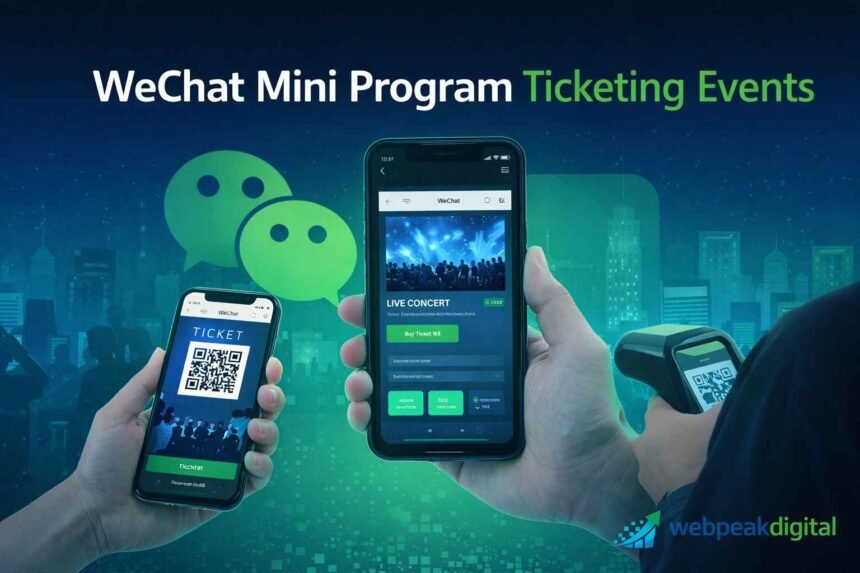
WeChat mini program ticketing events are changing how events are discovered, purchased, and managed inside China’s most widely used digital ecosystem. Instead of pushing users to external websites or standalone apps, this model keeps the entire ticketing journey inside WeChat, from first click to venue entry. For event teams, this shifts ticketing from a separate system into a core part of audience engagement and operations.
For organizers targeting mobile-first audiences, wechat mini program ticketing events offer a practical way to reduce friction, improve conversion, and maintain control over data and access. The approach aligns with how users already behave on WeChat chatting, paying, and sharing making ticket purchases feel like a natural extension of everyday activity rather than a separate task.
What Are WeChat Mini Program Ticketing Events
WeChat Mini Program ticketing events are event ticketing systems built directly inside the WeChat ecosystem.
They allow users to discover events, buy tickets, receive QR codes, and enter venues without leaving WeChat.
These systems operate as lightweight applications:
-
No app installation required
-
Accessed via search, QR codes, or shared links
-
Fully integrated with WeChat Pay and user accounts
They are commonly used for events targeting audiences active on WeChat.
Definition of event ticketing via WeChat Mini Programs
Event ticketing via WeChat Mini Programs means selling and managing event tickets inside WeChat using official mini apps.
The entire ticket lifecycle happens within one environment.
Key characteristics include:
-
Built-in payment and identity verification
-
Digital tickets tied to a user’s WeChat ID
-
Real-time updates and notifications
This setup reduces friction for both buyers and organizers.
How ticketing mini programs differ from standalone apps
Ticketing mini programs differ from standalone apps by removing installation and login barriers.
Users interact with them instantly inside WeChat.
Main differences:
-
No separate app download or account creation
-
Faster checkout using stored payment credentials
-
Easier sharing through chats, Moments, and QR codes
This design prioritizes speed and convenience over deep customization.
Typical event scenarios using WeChat ticketing
WeChat ticketing is most commonly used for events with mobile-first, socially connected audiences.
It fits both large-scale and small-format events.
Common examples include:
-
Conferences, exhibitions, and trade shows
-
Concerts, festivals, and cultural events
-
Workshops, classes, and private gatherings
It is especially effective for events promoted through social channels.
How WeChat Mini Program Event Ticketing Works
WeChat Mini Program event ticketing follows a streamlined, mobile-first process from discovery to entry.
Each step is designed to minimize user effort.
The system combines:
-
Event promotion
-
Payment processing
-
Digital ticket delivery
-
On-site validation
All steps occur within WeChat.
User journey from event discovery to ticket validation
Users move from discovering an event to validating entry in a single, continuous flow.
There are no platform switches.
Typical journey:
-
User finds the event via QR code, search, or shared link
-
Event page opens inside the mini program
-
Ticket selection and checkout happen immediately
-
QR ticket is stored in the mini program
This flow reduces drop-off points.
Payment and ticket issuance process
Payment and ticket issuance are handled instantly through WeChat Pay.
Tickets are generated as digital credentials tied to the user.
Process steps:
-
User confirms ticket type and quantity
-
Payment is completed using WeChat Pay
-
A QR code or digital pass is issued
-
Ticket appears in the mini program or message history
This reduces payment failures and manual reconciliation.
Entry verification and on-site check-in flow
Entry verification relies on scanning digital tickets at the venue.
Validation is fast and requires minimal hardware.
Standard setup includes:
-
Staff scanning QR codes using a validation app or device
-
Real-time confirmation of ticket status
-
Automatic prevention of duplicate entry
This supports high-volume check-in with fewer staff.
Who Uses WeChat Mini Program Ticketing Systems
WeChat ticketing systems serve multiple stakeholders across the event ecosystem.
Each group benefits in different ways.
The system is designed for:
-
Event organizers
-
Ticket buyers
-
Partners and venues
All interact through the same platform.
Event organizers and promoters
Event organizers use WeChat ticketing to manage sales, access, and attendee data.
It simplifies operations and reporting.
Organizers typically rely on it for:
-
Ticket inventory control
-
Payment settlement
-
Attendee communication
It reduces reliance on external tools.
Attendees and ticket buyers
Attendees use WeChat ticketing for fast, mobile-based access to events.
The experience is familiar and low-effort.
From the attendee perspective:
-
No new accounts are required
-
Tickets are easy to retrieve
-
Entry is quick and contactless
This lowers confusion at the venue.
Partners, venues, and sponsors
Partners and venues use ticketing data to coordinate operations and promotions.
Sponsors benefit from visibility inside WeChat.
Typical uses include:
-
Capacity planning and access control
-
Branded ticket pages or messages
-
Post-event engagement opportunities
This supports better coordination across parties.
Why WeChat Mini Program Ticketing Matters for Events
WeChat ticketing matters because it aligns with how users already behave on mobile.
It meets people where they already spend time.
The platform combines:
-
Messaging
-
Payments
-
Discovery
-
Identity
This creates a closed-loop event experience.
The role of WeChat’s ecosystem in event conversion
WeChat’s ecosystem improves conversion by reducing decision and payment friction.
Users trust the platform and its payment system.
Key factors include:
-
Familiar interface
-
Stored payment credentials
-
Social proof through sharing
This increases the likelihood of completed purchases.
Impact on user experience and purchase friction
Purchase friction is lower because users never leave the platform.
Fewer steps lead to fewer abandoned purchases.
Improvements include:
-
Shorter checkout flows
-
Fewer login prompts
-
Immediate confirmation
This is especially important for mobile users.
Strategic importance for China-focused and cross-border events
WeChat ticketing is strategically important for events targeting China-based or WeChat-heavy audiences.
It aligns with local user habits.
For cross-border events:
-
WeChat Pay supports RMB transactions
-
Communication happens in a familiar channel
-
Entry management remains centralized
This reduces barriers for international organizers.
Key Benefits for Event Organizers
Event organizers benefit from higher efficiency and better visibility into ticket sales.
The system reduces operational overhead.
Benefits span:
-
Sales
-
Management
-
Data
All within one platform.
Increased ticket sales and conversion rates
Conversion rates improve due to faster checkout and trusted payments.
Users complete purchases more often.
Key drivers include:
-
Fewer steps to buy
-
Integrated payments
-
Easy social sharing
These factors directly impact revenue.
Centralized event management inside WeChat
Event management is centralized within the WeChat admin environment.
Organizers manage tickets, users, and access in one place.
This allows:
-
Real-time sales tracking
-
Ticket validation control
-
Simplified refunds and changes
It reduces tool sprawl.
Data insights and audience retargeting opportunities
WeChat ticketing provides first-party data tied to user profiles.
This data supports future event planning.
Common insights include:
-
Purchase behavior
-
Attendance rates
-
Engagement after the event
These insights help refine future campaigns.
Key Benefits for Event Attendees
Attendees benefit from speed, clarity, and reliability.
The process feels familiar and predictable.
Most users already understand how WeChat works.
Faster ticket purchase without app downloads
Tickets can be purchased without downloading or registering for anything new.
This saves time and storage.
From the user’s view:
-
One tap to open
-
One tap to pay
-
Immediate confirmation
This supports impulse purchases.
Secure mobile tickets and QR code access
Mobile tickets are securely linked to a user’s WeChat account.
This reduces fraud and ticket loss.
Security features include:
-
Unique QR codes
-
Real-time validation
-
Account-level binding
Tickets are easy to retrieve when needed.
Post-event engagement and updates within WeChat
Post-event communication continues inside WeChat.
Users do not miss updates.
Common uses include:
-
Event reminders
-
Schedule changes
-
Follow-up messages
This keeps communication centralized.
Best Practices for WeChat Mini Program Event Ticketing
Best practices focus on simplicity, speed, and reliability.
Complexity reduces conversion.
Design and operations should support mobile behavior.
Designing a frictionless ticket purchase flow
A frictionless flow minimizes steps between discovery and payment.
Every extra screen increases drop-off.
Best practices include:
-
Clear ticket pricing
-
Minimal form fields
-
Prominent payment buttons
Users should complete purchases quickly.
Optimizing mini program performance and UX
Performance directly affects user trust and completion rates.
Slow loading leads to abandonment.
Key considerations:
-
Lightweight design
-
Fast page loads
-
Clear navigation
Testing on multiple devices is critical.
Leveraging social sharing and WeChat features
WeChat’s built-in sharing tools support organic promotion.
Users can promote events unintentionally.
Effective tactics include:
-
Shareable event pages
-
QR codes for offline promotion
-
Group chat distribution
This extends reach without extra tools.
Technical and Compliance Requirements to Consider
WeChat ticketing systems must meet platform and regulatory requirements.
Compliance affects approval and payment access.
Requirements apply to:
-
Developers
-
Organizers
-
Payment handlers
Ignoring them can block operations.
WeChat Mini Program registration and verification
Mini programs require official registration and verification.
This confirms the operator’s identity.
Typical requirements:
-
Business registration documents
-
Account verification
-
Platform review approval
This process can take time.
WeChat Pay and payment compliance requirements
WeChat Pay integration requires financial and identity checks.
Not all entities qualify immediately.
Compliance areas include:
-
Business licensing
-
Settlement accounts
-
Transaction monitoring
Approval is mandatory before ticket sales.
Data privacy, security, and regulatory considerations
User data must be handled according to local regulations.
This includes storage and usage rules.
Common obligations:
-
Data minimization
-
Secure storage
-
Clear user consent
Non-compliance creates legal risk.
Common Mistakes and Risks in WeChat Ticketing Events
Most failures come from poor planning or incomplete setup.
These issues affect user trust and event operations.
Risks span:
-
Design
-
Payments
-
On-site execution
They are avoidable with preparation.
Poor mini program navigation and checkout design
Confusing design leads to abandoned purchases.
Users expect clarity and speed.
Common problems include:
-
Hidden pricing
-
Too many steps
-
Unclear confirmation screens
Testing with real users helps prevent this.
Payment setup and settlement issues
Payment issues delay ticket issuance and refunds.
They also create support workload.
Typical causes:
-
Incorrect account configuration
-
Settlement delays
-
Currency or tax mismatches
These should be resolved before launch.
Operational and on-site ticket validation failures
On-site failures disrupt entry and frustrate attendees.
They often stem from poor testing.
Common issues:
-
Scanner connectivity problems
-
Staff unfamiliarity
-
Duplicate or invalid scans
Dry runs reduce these risks.
Tools and Platforms for Building WeChat Ticketing Mini Programs
Event organizers can choose between custom development and ready-made platforms.
The choice depends on scale and complexity.
Both approaches have trade-offs.
Custom development vs third-party ticketing solutions
Custom development offers flexibility, while third-party tools offer speed.
Each suits different needs.
Comparison points:
-
Custom builds allow tailored workflows
-
Third-party tools reduce setup time
-
Costs vary by scale and features
Decision-making should match event volume.
Integration with CRM, analytics, and marketing tools
Integrations improve visibility and follow-up.
They turn ticketing into a data source.
Common integrations include:
-
CRM systems
-
Analytics dashboards
-
Messaging automation
These support long-term planning.
Scalability and maintenance considerations
Scalability matters for high-volume or recurring events.
Systems must handle traffic spikes.
Key considerations:
-
Load handling
-
Ongoing updates
-
Support availability
Maintenance planning avoids last-minute issues.
Step-by-Step Checklist for Launching a WeChat Ticketing Event
Launching a WeChat ticketing event requires structured preparation.
A checklist reduces overlooked steps.
Each phase has specific tasks.
Pre-launch setup and approvals
Pre-launch focuses on approvals and technical readiness.
Nothing should be left untested.
Checklist items:
-
Mini program approval
-
Payment account verification
-
Ticket logic testing
This phase prevents launch delays.
Event promotion and traffic acquisition
Promotion relies on WeChat-native channels.
Traffic sources should be planned early.
Common methods:
-
QR codes
-
Official account posts
-
Group and peer sharing
Tracking links help measure effectiveness.
Post-event analysis and follow-up
Post-event work turns ticketing data into insights.
This phase is often overlooked.
Typical actions:
-
Sales and attendance review
-
User engagement analysis
-
Follow-up messaging
These insights improve future events.
WeChat Mini Program Ticketing vs Other Event Ticketing Options
WeChat ticketing differs from traditional platforms in reach and user behavior.
Each option serves different contexts.
Comparisons help determine fit.
Comparison with traditional web-based ticketing platforms
Web-based platforms require browser access and manual input.
WeChat reduces these steps.
Key differences:
-
Web requires separate payment entry
-
WeChat uses stored credentials
-
WeChat supports in-app sharing
This affects mobile conversion rates.
Differences between WeChat and native mobile apps
Native apps offer deeper features but higher barriers.
WeChat favors convenience.
Comparison highlights:
-
Apps require downloads
-
Mini programs open instantly
-
Maintenance costs differ
Choice depends on long-term strategy.
When WeChat mini programs are the best choice
WeChat mini programs are best for mobile-first, socially driven events.
They excel in speed and accessibility.
They work best when:
-
Audience already uses WeChat
-
Fast setup is required
-
Social sharing drives sales
Context matters more than features.
Frequently Asked Questions
What are WeChat mini program ticketing events and how do they work?
WeChat mini program ticketing events are event ticketing systems built directly inside WeChat, allowing users to discover events, buy tickets, and enter venues without leaving the app. Tickets are usually issued as QR codes linked to the user’s WeChat account and validated on-site through scanning.
Can international users purchase tickets through WeChat ticketing mini programs?
Yes, international users can purchase tickets as long as they have a verified WeChat account and access to supported payment methods. Availability depends on whether the organizer has enabled cross-border payment and currency settlement.
Do event organizers need technical knowledge to set up ticketing in WeChat?
No technical background is required if organizers use third-party ticketing platforms or no-code solutions. Custom-built mini programs, however, do require development resources and ongoing technical support.
What types of events are best suited for WeChat-based ticketing?
Events with mobile-first audiences perform best, including conferences, exhibitions, concerts, workshops, and community events. It is especially effective when promotion relies on social sharing and QR code distribution.
Is WeChat ticketing secure for payments and entry management?
Yes, payments are processed through WeChat Pay, and tickets are tied to individual user accounts. QR code validation and real-time status checks help prevent fraud and duplicate entry.