

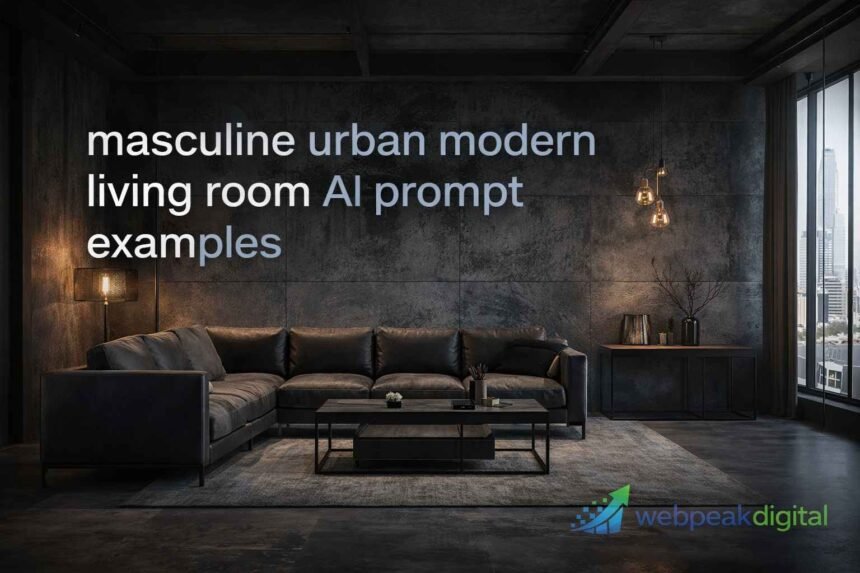
Designing a masculine urban modern living room often starts with a clear visual goal but limited ways to test ideas quickly. Traditional mood boards and reference images help, but they don’t always capture how materials, lighting, and layout work together in a real space. That gap is where AI-generated visuals have become useful for professionals and serious DIY planners.
Masculine urban modern living room AI prompt examples give designers and users a practical way to translate style intent into clear, repeatable visual outputs. When prompts are written correctly, they help AI tools generate images that reflect real design logic—proportions, materials, and atmosphere—rather than generic or overly stylized rooms. This approach supports faster concept validation and more consistent results across different tools.
What Is a Masculine Urban Modern Living Room Style
A masculine urban modern living room style combines modern design principles with strong materials, muted colors, and a structured layout inspired by city living.
This style focuses on function, restraint, and visual weight rather than decoration or softness. It often reflects professional, minimalist, and industrial influences.
Core characteristics of masculine interior design
Masculine interior design emphasizes strength, clarity, and intentional restraint.
Key characteristics include:
-
Clean lines with minimal ornamentation
-
Visual balance through symmetry or structured asymmetry
-
Preference for function over decorative elements
-
Furniture and finishes that feel solid and grounded
The goal is a space that feels controlled, confident, and practical.
Defining elements of urban modern living spaces
Urban modern spaces reflect city architecture and contemporary lifestyles.
Common elements include:
-
Open floor plans with defined zones
-
Industrial influences like exposed concrete or steel
-
Large windows or city-facing views
-
Minimal clutter and efficient use of space
These rooms are designed to feel modern, efficient, and adaptable.
How masculinity is expressed through materials and color
Masculinity in design is expressed through material choice and restrained color use.
Typical approaches include:
-
Dark or neutral color palettes
-
Natural materials with visible texture
-
Matte finishes instead of glossy surfaces
-
Limited accent colors used intentionally
These choices create a composed and mature visual tone.
What Are AI Prompt Examples in Interior Design
AI prompt examples are structured text instructions used to guide image-generation tools to produce specific interior design visuals.
They translate design intent into language that AI systems can interpret consistently.
How AI prompts are used to generate room visuals
AI prompts describe a space in enough detail for the system to generate an image.
A typical prompt includes:
-
Room type and layout
-
Design style and mood
-
Materials, colors, and lighting
-
Perspective or realism level
The AI converts these descriptions into visual outputs.
Differences between generic and style-specific prompts
Generic prompts describe a room broadly, while style-specific prompts control outcomes more precisely.
Key differences:
-
Generic prompts produce inconsistent results
-
Style-specific prompts reduce randomness
-
Focused prompts reflect clearer design intent
-
Specific language improves visual accuracy
For interior design, specificity directly affects quality.
Why prompt precision matters for interior outcomes
Prompt precision determines whether AI outputs align with real design expectations.
Precise prompts:
-
Reduce unrealistic layouts
-
Improve material accuracy
-
Control lighting and mood
-
Match professional design standards
Without precision, results often feel generic or impractical.
How AI Image Generation Works for Living Room Concepts
AI image generation uses trained models to convert text descriptions into visual representations of living spaces.
The system relies entirely on how clearly the prompt communicates design intent.
Text-to-image workflow explained
The workflow follows a predictable sequence.
Steps include:
-
User inputs a text prompt
-
AI interprets style, objects, and relationships
-
The model generates multiple image variations
-
Outputs reflect probability, not certainty
Results improve through iteration and refinement.
Interpreting style, mood, and spatial cues
AI interprets descriptive cues statistically, not emotionally.
Important cues include:
-
Adjectives that describe mood
-
Spatial terms like “open-plan” or “compact”
-
Material references tied to known visual data
-
Lighting descriptors that guide contrast
Clear cues help the model prioritize visual elements.
Limitations of AI when visualizing interiors
AI tools still struggle with certain interior constraints.
Common limitations:
-
Inaccurate room proportions
-
Unrealistic furniture scale
-
Structural inconsistencies
-
Limited understanding of building codes
AI outputs should be treated as concept visuals, not final plans.
Key Design Elements to Include in Masculine Urban Prompts
Effective prompts include specific design elements that define both masculinity and urban modern style.
Leaving these out leads to generic results.
Color palettes that reinforce a masculine aesthetic
Masculine palettes rely on neutral and dark tones.
Common choices include:
-
Charcoal, black, and slate gray
-
Warm browns and deep wood tones
-
Muted blues or greens as accents
-
Low-saturation color schemes
These palettes create visual stability and restraint.
Materials, textures, and finishes that define the style
Material selection signals masculinity more than decoration.
Typical materials include:
-
Leather upholstery
-
Concrete or stone surfaces
-
Dark-stained wood
-
Brushed metal or steel
Texture contrast adds depth without clutter.
Furniture types and layout considerations
Furniture choices reinforce function and structure.
Common considerations:
-
Low-profile seating with clean lines
-
Modular or sectional sofas
-
Minimal but substantial tables
-
Clear walking paths and defined zones
Layouts favor order and efficiency over softness.
How to Structure an Effective AI Prompt for Living Rooms
An effective prompt follows a clear structure that mirrors how AI models interpret information.
Order and clarity matter more than length.
Essential prompt components and order
Prompts perform best when components follow a logical sequence.
Recommended order:
-
Room type and size
-
Design style and era
-
Materials and color palette
-
Lighting conditions
-
Perspective and realism level
This reduces conflicting instructions.
Describing lighting, perspective, and realism
Lighting and perspective control how realistic the image feels.
Effective descriptions include:
-
Natural vs artificial lighting
-
Time of day
-
Camera angle or lens type
-
Photorealistic or stylized output
These details shape depth and mood.
Using modifiers for mood and atmosphere
Modifiers refine emotional tone without changing structure.
Common modifiers:
-
“Moody,” “minimal,” or “industrial”
-
“Soft shadows” or “high contrast”
-
“Calm,” “dramatic,” or “refined”
Modifiers should support, not contradict, the main style.
Masculine Urban Modern Living Room AI Prompt Examples
Well-constructed prompt examples demonstrate how structure and detail work together.
They serve as templates rather than fixed formulas.
Photorealistic living room prompt examples
Photorealistic prompts aim for realistic materials and lighting.
They typically include:
-
Natural light descriptions
-
Real-world textures
-
Accurate scale and proportions
-
Camera-style perspective
These outputs resemble professional interior photography.
Minimalist and industrial prompt variations
Minimalist and industrial prompts reduce visual noise.
They focus on:
-
Fewer objects
-
Exposed materials
-
Neutral color dominance
-
Strong geometric forms
The result feels clean and architectural.
Luxury and high-end urban prompt styles
Luxury prompts emphasize refinement rather than excess.
They often include:
-
Premium materials
-
Balanced lighting
-
Subtle contrast
-
Spacious layouts
Luxury is communicated through restraint and detail quality.
Prompt Variations by AI Tool
Different AI platforms interpret prompts differently.
Adapting structure improves consistency across tools.
Midjourney prompt structure and syntax
Midjourney responds well to descriptive stacking.
Best practices include:
-
Clear style keywords
-
Ordered descriptors
-
Use of aspect ratio and quality flags
-
Controlled use of modifiers
Syntax affects output predictability.
DALL•E prompt best practices
DALL•E prioritizes clarity and natural language.
Effective prompts:
-
Use plain descriptive sentences
-
Avoid excessive modifiers
-
Clearly state room function
-
Limit abstract phrasing
Simple language performs better.
Stable Diffusion prompt considerations
Stable Diffusion allows deeper technical control.
Considerations include:
-
Positive and negative prompts
-
Weighting specific terms
-
Model and checkpoint selection
-
Seed consistency
This tool suits advanced users.
Why Masculine Urban Prompt Design Matters
Prompt design directly impacts output reliability and usefulness.
Poor prompts waste time and reduce quality.
Improving visual consistency and realism
Consistent prompts produce consistent visuals.
This helps:
-
Maintain a unified design direction
-
Compare variations accurately
-
Avoid style drift between generations
Consistency is critical for professional use.
Reducing trial-and-error generations
Structured prompts reduce unnecessary iterations.
Benefits include:
-
Lower compute usage
-
Faster concept development
-
More predictable outcomes
Efficiency improves workflow quality.
Aligning AI outputs with real-world design goals
Well-designed prompts reflect real design constraints.
This alignment:
-
Improves communication with stakeholders
-
Supports design planning discussions
-
Avoids unrealistic concepts
AI becomes a support tool, not a distraction.
Benefits of Using AI Prompts for Living Room Design
AI prompting provides practical value across multiple roles.
The benefits vary by use case.
Benefits for designers and architects
Professionals use AI for early-stage ideation.
Key benefits:
-
Rapid concept exploration
-
Visual alignment with clients
-
Reduced manual sketching
AI supports, not replaces, expertise.
Benefits for homeowners and DIY planners
Homeowners use AI to visualize ideas before committing.
Benefits include:
-
Better design confidence
-
Clearer communication with contractors
-
Reduced guesswork
Visual clarity improves decision-making.
Benefits for content creators and marketers
Creators use AI visuals for storytelling and branding.
Use cases include:
-
Concept art
-
Social media visuals
-
Mood boards
Prompts enable fast content production.
Best Practices for High-Quality AI Living Room Results
Best practices focus on clarity, control, and iteration.
They reduce errors and improve realism.
Using reference styles and constraints
Constraints guide AI behavior.
Effective constraints include:
-
Named styles or eras
-
Material limits
-
Color restrictions
Constraints improve focus.
Balancing creativity with specificity
Creativity works best within boundaries.
Balanced prompts:
-
Allow variation within a defined style
-
Avoid conflicting instructions
-
Focus on outcomes, not decoration
Specificity supports creativity.
Iterating prompts for refined outputs
Iteration is part of the process.
A practical approach:
-
Start broad
-
Refine one variable at a time
-
Save successful prompt versions
Small changes produce meaningful improvements.
Common Mistakes When Writing Interior Design AI Prompts
Most prompt issues come from unclear thinking, not technical limits.
Avoiding common mistakes improves results immediately.
Overloading prompts with conflicting styles
Conflicting styles confuse AI models.
Examples include:
-
Mixing minimalist and ornate styles
-
Combining luxury and raw industrial cues
-
Using too many adjectives
Focus on one clear direction.
Being too vague or too abstract
Vague prompts produce generic outputs.
Problems include:
-
Undefined materials
-
No lighting direction
-
Abstract mood terms
Concrete descriptions work better.
Ignoring scale, proportions, and realism
Ignoring scale leads to unusable visuals.
Common issues:
-
Oversized furniture
-
Unrealistic room dimensions
-
Poor spatial logic
Explicit size and layout cues help.
Tools and Techniques to Improve AI Interior Prompting
Supporting tools improve control and consistency.
They help standardize results.
Prompt builders and style libraries
Prompt tools provide reusable frameworks.
They help by:
-
Reducing setup time
-
Enforcing structure
-
Storing successful prompts
Libraries improve consistency across projects.
Using seed images and references
Reference images anchor visual direction.
Benefits include:
-
More predictable outputs
-
Closer alignment to real spaces
-
Reduced randomness
References guide AI interpretation.
Post-generation refinement techniques
Refinement improves final quality.
Common techniques:
-
Re-running prompts with minor tweaks
-
Upscaling selected outputs
-
Editing lighting or contrast
Post-processing completes the workflow.
Actionable Checklist for Writing Masculine Urban Living Room Prompts
Checklists help validate prompt readiness before generation.
They reduce avoidable errors.
Style and mood validation checklist
Confirm the following:
-
Clear design style defined
-
Mood descriptors aligned
-
No conflicting aesthetics
Style clarity comes first.
Technical prompt optimization checklist
Verify technical elements:
-
Proper prompt order
-
Lighting specified
-
Perspective included
Technical clarity improves realism.
Quality control before generating images
Final checks include:
-
Consistent terminology
-
Realistic materials
-
Logical layout cues
Quality control saves time.
Frequently Asked Questions
What keywords work best for masculine living room prompts
The most effective keywords focus on materials, structure, and mood rather than trends or abstract style labels. Terms like dark wood, leather seating, concrete walls, matte black finishes, neutral color palette, industrial lighting, and clean-lined furniture help AI tools understand the physical qualities of the space. Using clear descriptors for lighting, layout, and realism level usually produces more consistent results than relying on vague aesthetic words.
Can AI prompts replace interior designers
AI prompts cannot replace interior designers because they do not account for structural constraints, building codes, ergonomics, or client-specific needs. AI-generated visuals are best used as conceptual aids that support early ideation, client communication, or personal inspiration. Designers still provide the critical judgment needed to translate visuals into functional, safe, and buildable spaces.
How realistic can masculine urban modern living room AI prompt examples be
Masculine urban modern living room AI prompt examples can produce highly realistic images when prompts include accurate materials, lighting conditions, and spatial cues. The realism is visual rather than technical, meaning the images may look convincing but should not be treated as construction-ready designs. They work best as reference visuals to guide discussions, validate style direction, or explore layout concepts before professional planning begins.