

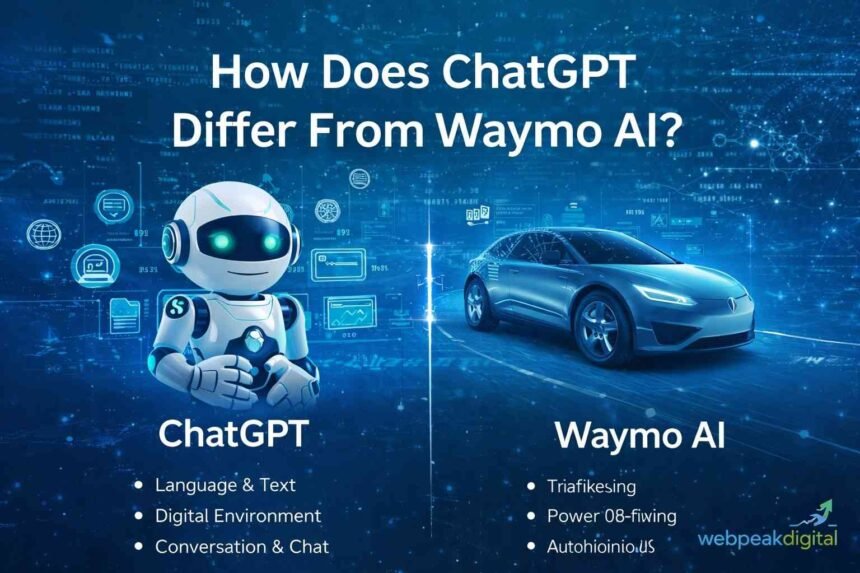
Artificial intelligence is used in many different ways, which is why people often ask how does ChatGPT differ from Waymo AI. Both are called AI, but they are built for completely different purposes. One works with language and text, while the other operates vehicles in the real world. Understanding this difference helps clear up confusion about what each system can actually do.
ChatGPT is designed to support communication, writing, and problem solving in digital environments. Waymo AI, on the other hand, is built to handle driving tasks safely without human control. Comparing them is useful, not because they compete with each other, but because it shows how broad the term “AI” really is and why context matters when discussing its impact.
What Is ChatGPT and What Is Waymo AI?
ChatGPT and Waymo AI are both artificial intelligence systems, but they are built for very different jobs.
One works with language and text. The other works in the real world by driving cars.
Understanding what each one is helps avoid confusion about what they can and cannot do.
Definition of ChatGPT as a Generative Language Model
ChatGPT is a software system that creates text based on what a user asks.
It responds by predicting the most likely words that fit the question.
• Reads and writes human language
• Answers questions and explains topics
• Helps with writing, research, and coding
• Only works in digital spaces
Definition of Waymo AI as an Autonomous Driving System
Waymo AI is a driving system that controls vehicles without a human driver.
It uses sensors and software to safely move a car through traffic.
• Drives cars in real streets
• Detects people, vehicles, and road signs
• Makes driving decisions on its own
• Focuses heavily on safety
Why These Two AI Systems Are Often Compared
These systems are compared because people use the word “AI” for both.
The comparison usually comes from misunderstanding, not from real similarity.
• Both use machine learning
• Both are built by major tech companies
• Their purposes are completely different
What Problems Are ChatGPT and Waymo AI Designed to Solve?
Each system solves a different type of problem.
ChatGPT solves language problems. Waymo AI solves movement and driving problems.
Language Understanding and Content Generation Use Cases
ChatGPT is made to help with language-based tasks.
It supports thinking, writing, and explaining information.
• Writing emails and documents
• Explaining complex ideas
• Helping with study or research
• Assisting with software code
Real-World Navigation and Driving Automation Use Cases
Waymo AI is made to move vehicles safely.
Its job is to handle driving in busy, real-world conditions.
• Self-driving taxi services
• City and highway driving
• Detecting hazards on the road
• Reducing human driving errors
Digital vs Physical Problem Domains
The biggest difference is where each system works.
One works with words. The other works with real-world movement.
• ChatGPT works with text and ideas
• Waymo AI works with space, speed, and objects
• Mistakes in text are low risk
• Mistakes in driving are high risk
How Does ChatGPT Work at a High Level?
ChatGPT works by learning patterns in language.
It does not think or understand like a human.
Large Language Models and Neural Networks
ChatGPT uses a large language model to predict words.
It looks at context and chooses the next likely word.
• Built using neural networks
• Trained on large amounts of text
• Focuses on sentence flow and meaning
Training Data and Pattern Recognition
ChatGPT learns during training, not while chatting.
It does not search the internet in real time.
• Learns grammar and writing styles
• Recognizes common question patterns
• Does not know facts the way humans do
Prompt-Based Interaction and Outputs
ChatGPT only responds when someone asks a question.
It does not act on its own.
• User writes a prompt
• System replies with text
• No physical actions involved
How Does Waymo AI Work at a High Level?
Waymo AI works by watching the world around the car.
It constantly checks what is happening and reacts fast.
Sensor Fusion: Cameras, LiDAR, and Radar
Waymo AI uses several sensors together.
Each sensor helps the car understand its surroundings.
• Cameras see lanes and traffic lights
• LiDAR measures distance and shape
• Radar tracks movement and speed
Perception, Prediction, and Motion Planning
Waymo AI breaks driving into steps.
Each step handles a specific task.
• Perception sees what is around
• Prediction guesses what others will do
• Planning chooses safe driving moves
Real-Time Decision Making in Traffic Environments
Waymo AI makes decisions every second.
These decisions must always prioritize safety.
• Reacts faster than humans
• Follows traffic rules strictly
• Tested through millions of miles
What Types of Data Do ChatGPT and Waymo AI Use?
Data type controls what an Ai Search Performance system can do.
Language data and driving data are not interchangeable.
Textual and Multimodal Data in ChatGPT
ChatGPT mainly uses written language.
Some versions also understand images or audio.
• Books and articles
• Online conversations
• Code and technical text
Visual, Spatial, and Sensor Data in Waymo AI
Waymo AI uses live data from the physical world.
This data changes every moment.
• Camera images
• Distance measurements
• Movement signals
Why Data Type Determines AI Capabilities
An AI system can only act on the data it receives.
Wrong data means wrong decisions.
• ChatGPT cannot judge distance or speed
• Waymo AI cannot write or explain topics
• Each system stays within its limits
How Do User Interaction Models Differ Between ChatGPT and Waymo AI?
Users interact with these systems in very different ways.
One is conversational. The other is hands-off.
Conversational Interfaces and Human Prompts
ChatGPT works through conversation.
The user stays in control.
• User asks questions
• User reviews answers
• User decides what to do
Autonomous Systems With No Direct User Control
Waymo AI runs without user guidance.
Passengers do not control driving.
• No prompts or commands
• System makes all driving choices
• Designed for independence
Human-in-the-Loop vs Fully Autonomous Operation
ChatGPT always supports humans.
Waymo AI replaces the human driver.
• ChatGPT assists decisions
• Waymo AI executes decisions
Why the Differences Between ChatGPT and Waymo AI Matter
These differences affect safety, law, and trust.
Treating them the same creates serious risk.
Impact on Safety, Reliability, and Risk
The results of failure are not equal.
Driving systems face much higher consequences.
• ChatGPT errors affect information
• Waymo AI errors affect lives
• Safety standards reflect this gap
Implications for Regulation and Oversight
Waymo AI faces strict rules.
ChatGPT follows lighter guidelines.
• Vehicle safety laws
• Road testing approvals
• AI governance policies
Business and Societal Impact Differences
Each system changes different industries.
Their effects do not overlap much.
• ChatGPT changes office work
• Waymo AI changes transport
• Timelines and risks differ
Benefits of ChatGPT Compared to Waymo AI
ChatGPT’s value is speed and flexibility.
It is easy to adopt and low risk.
Benefits for Individuals and Knowledge Workers
ChatGPT helps people work faster.
It supports thinking, not action.
• Drafts and summaries
• Learning support
• Research help
Benefits for Businesses and Enterprises
Companies use ChatGPT to manage information.
It fits into existing workflows.
• Customer support
• Internal tools
• Documentation help
Scalability and Accessibility Advantages
ChatGPT scales easily.
It does not need physical assets.
• Cloud-based access
• Global availability
• Fast updates
Benefits of Waymo AI Compared to ChatGPT
Waymo AI’s value is safety and automation.
Its impact is long term and structural.
Transportation Safety and Accident Reduction
Waymo AI aims to reduce crashes.
It removes common human errors.
• No fatigue
• No distraction
• Consistent decisions
Urban Mobility and Logistics Improvements
Waymo AI changes how cities move.
It supports new transport models.
• Driverless taxis
• Delivery services
• Better traffic flow
Long-Term Economic and Infrastructure Benefits
Waymo AI affects city planning.
Its benefits appear over time.
• Lower accident costs
• New job categories
• Infrastructure changes
Safety, Ethics, and Compliance Considerations
Each system has different risks.
Rules reflect those risks.
AI Accuracy and Hallucination Risks in ChatGPT
ChatGPT can sound confident and be wrong.
Human review is necessary.
• Always verify output
• Avoid final decisions
• Use as support only
Physical Safety and Liability Risks in Waymo AI
Waymo AI failures carry legal impact.
Safety testing is critical.
• Liability concerns
• Insurance requirements
• Public trust issues
Regulatory Frameworks Governing Each System
Regulation matches risk level.
Driving systems face stricter rules.
• AI content policies
• Vehicle safety laws
Common Misconceptions About ChatGPT and Waymo AI
Many misunderstandings come from the word “AI.”
Context matters.
“All AI Systems Work the Same Way”
AI systems are task-specific.
Design depends on purpose.
• Different data
• Different risks
• Different limits
“ChatGPT Can Power Self-Driving Cars”
ChatGPT cannot drive vehicles.
It lacks real-world awareness.
• No sensors
• No motion control
• No safety approval
“Waymo AI Is Just Another Chatbot”
Waymo AI does not talk.
It acts in the physical world.
• Focuses on movement
• Built for safety
• Not conversational
ChatGPT vs Waymo AI: Side-by-Side Comparison
The comparison highlights purpose, not similarity.
Each system serves a different role.
Core Purpose and Functionality
Their goals do not overlap.
• ChatGPT supports communication
• Waymo AI controls vehicles
Technology Stack and Architecture
Their technical foundations are different.
• Language models vs sensor systems
• Cloud processing vs vehicle hardware
Risk Profile and Real-World Impact
Risk defines design choices.
• Information risk vs physical risk
• Advisory vs operational systems
How to Choose the Right AI Approach for Your Needs
Choosing the wrong system creates risk.
Match the tool to the task.
When Conversational AI Is the Right Fit
Use ChatGPT for language-based work.
• Writing and research
• Knowledge support
• Idea development
When Autonomous Systems Are Required
Use Waymo AI for driving tasks.
• Transport services
• Logistics
• Controlled road environments
Why These AI Types Are Not Interchangeable
They are built for different worlds.
• Different inputs
• Different responsibilities
• Different legal standards
Frequently Asked Questions
How does ChatGPT differ from Waymo AI in simple terms?
ChatGPT works with language and text, while Waymo AI works with driving and movement. ChatGPT helps people write, explain, and understand information, but Waymo AI controls vehicles and makes real-time decisions on the road. They solve very different problems and are not used for the same tasks.
Can ChatGPT be used to control self driving cars?
No, ChatGPT cannot control self-driving cars. It does not understand speed, distance, or physical surroundings. Driving systems like Waymo AI need sensors, safety testing, and real-time decision systems that ChatGPT does not have.
Why do people often confuse ChatGPT and Waymo AI?
People confuse them because both are labeled as artificial intelligence. The term AI is broad, and it covers many different technologies. ChatGPT and Waymo AI use different data, follow different rules, and operate in completely different environments.