
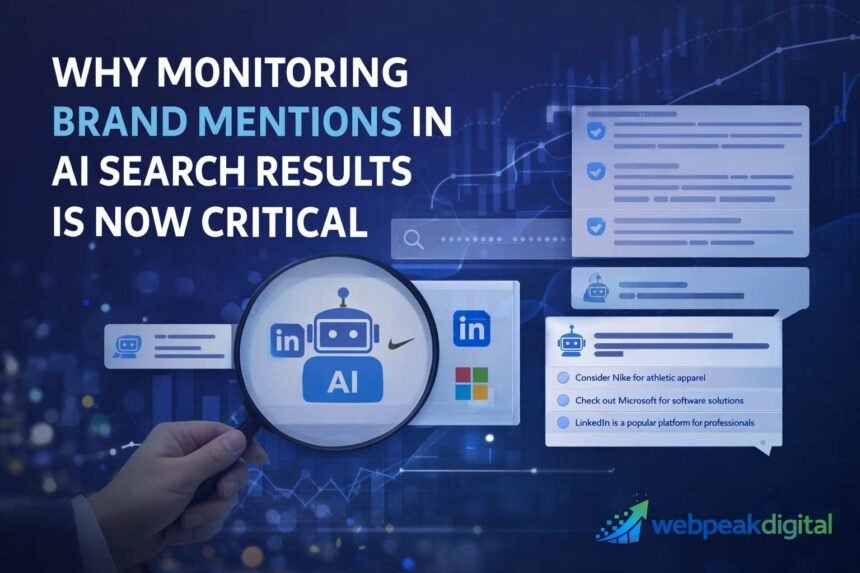
Search is no longer just about blue links and rankings. When people ask questions today, AI tools often answer directly—summarizing options, naming brands, and shaping decisions before a user ever sees a traditional search result. That shift changes where visibility happens and who controls it.
This is why you should monitor brand mentions in AI search results. These systems don’t simply reflect what you publish; they interpret, filter, and prioritize information based on signals of authority, accuracy, and relevance. If your brand is missing, misrepresented, or overshadowed by competitors, you may not even know it’s happening.
For organizations that care about reputation, compliance, and long-term visibility, AI-generated answers are now part of the public record. Understanding how and when your brand appears or doesn’t has become a necessary part of modern search oversight.
What Are Brand Mentions in AI Search Results?
Brand mentions in AI search results are references to a company, product, or service that appear directly within AI-generated answers rather than as clickable links. These mentions can shape how users understand and evaluate brands without visiting a website.
AI search tools summarize, recommend, and compare brands based on patterns in trusted data sources. This changes how visibility works and shifts control away from traditional rankings.
How AI Search Engines Generate Answers
AI search engines generate answers by combining trained knowledge with real-time or indexed sources. The goal is to return a direct response, not a list of pages.
-
Large language models identify relevant concepts and entities
-
Retrieval systems pull supporting information from indexed content
-
Answers are synthesized into a single response
-
Sources may or may not be explicitly shown
The output reflects what the system believes is most reliable and relevant at the time.
Explicit vs. Implicit Brand Mentions
Brand mentions appear in two main forms within AI-generated answers. Both influence perception, even if users do not notice the difference.
-
Explicit mentions name the brand directly
-
Implicit mentions describe a product or service without naming it
-
Implicit mentions often favor well-known brands by default
-
Users may still associate the description with a known company
Both forms affect brand recall and trust.
How AI Mentions Differ from Traditional SERP Listings
AI mentions differ from traditional search listings because they remove user choice. The system decides what to surface.
-
No visible ranking position
-
Fewer or no clickable links
-
Limited exposure to alternative brands
-
Higher influence on first impressions
This makes monitoring mentions more about presence than position.
How AI Search Results Surface and Reference Brands
AI search results surface brands based on data reliability, relevance, and consistency across sources. Visibility depends less on individual pages and more on overall brand signals.
Brands appear when AI systems recognize them as credible answers to a specific need.
Training Data, Retrieval Models, and Live Indexing
AI systems rely on multiple layers of information to reference brands accurately. Each layer plays a different role.
-
Training data establishes baseline knowledge
-
Retrieval models pull recent or verified content
-
Live indexing updates factual information
-
Conflicts are resolved using authority signals
Brands with consistent public data are more likely to be referenced.
The Role of Authoritative Sources and Citations
AI systems favor brands supported by authoritative sources. Authority is inferred, not declared.
-
Government and regulatory sites
-
Established publishers and industry bodies
-
Widely cited research or documentation
-
Reputable news coverage
If a brand lacks representation in these sources, visibility drops.
How Prompts Influence Brand Visibility
Brand visibility changes based on how users ask questions. Prompt structure shapes the response.
-
Broad prompts surface category leaders
-
Comparative prompts favor brands with clear differentiation
-
Risk-related prompts emphasize compliance and trust
-
Niche prompts may exclude well-known brands entirely
Monitoring requires testing prompts that reflect real user behavior.
Who Is Responsible for Monitoring AI Brand Mentions?
Monitoring AI brand mentions is a shared responsibility across multiple functions. No single team owns the full picture.
Clear ownership prevents blind spots and delayed response.
SEO and Organic Search Teams
SEO teams are responsible for understanding how brand presence shifts outside traditional rankings.
-
Track brand visibility across AI tools
-
Identify content gaps affecting mentions
-
Align optimization with entity recognition
-
Share insights with other teams
Their role extends beyond traffic metrics.
Brand, PR, and Communications Teams
Brand and communications teams manage how the organization is described and perceived.
-
Monitor tone and context of mentions
-
Identify reputational risks or inaccuracies
-
Ensure consistency in public messaging
-
Coordinate corrections when needed
AI references amplify messaging errors quickly.
Product Marketing and Competitive Intelligence Roles
Product and intelligence teams use AI mentions to understand market positioning.
-
Track competitor visibility
-
Identify emerging alternatives
-
Monitor category narratives
-
Support positioning and messaging decisions
AI responses often reveal market assumptions.
Why Monitoring Brand Mentions in AI Search Results Matters
Monitoring matters because AI search tools increasingly influence decisions before users reach a website. Absence or misrepresentation carries real risk.
Visibility now happens upstream from traditional search.
Impact on Brand Discovery and Awareness
AI tools act as a discovery layer for users researching options. Brand mentions shape early awareness.
-
Users rely on summarized answers
-
Fewer sources are considered
-
First impressions form quickly
-
Missing brands are rarely revisited
Discovery happens without clicks.
Influence on Trust and Perceived Authority
Brands mentioned by AI systems are often assumed to be credible. Silence can imply irrelevance.
-
AI references suggest validation
-
Omission raises questions
-
Inaccurate mentions damage trust
-
Corrections are difficult once assumptions form
Trust shifts from publishers to systems.
Loss of Visibility When Brands Are Omitted
When a brand is not mentioned, competitors gain exclusive exposure.
-
Users may never see alternatives
-
Buying decisions narrow early
-
Market share shifts quietly
-
Traditional SEO may not compensate
Omission is a competitive disadvantage.
Benefits of Monitoring AI Brand Mentions for Businesses
Monitoring provides visibility into how AI systems interpret and represent a brand. This supports better decisions across teams.
Benefits extend beyond marketing metrics.
Benefits for Marketing and SEO Teams
Marketing teams gain clarity on performance outside traditional channels.
-
Understand AI-driven visibility gaps
-
Align content with AI interpretation
-
Adjust messaging based on responses
-
Measure presence beyond rankings
This supports modern search strategy.
Benefits for Brand and Reputation Management
Reputation teams detect risks earlier when monitoring AI outputs.
-
Spot misleading descriptions
-
Identify outdated claims
-
Track sentiment over time
-
Reduce reputational exposure
AI errors scale quickly if ignored.
Benefits for Leadership and Strategic Planning
Leadership gains insight into how the market perceives the brand.
-
See competitive positioning shifts
-
Validate strategic narratives
-
Identify emerging risks
-
Support long-term planning
AI visibility reflects market reality.
How AI Brand Mentions Affect SEO and Search Performance
AI brand mentions influence search outcomes indirectly. They reshape how authority and relevance are interpreted.
SEO performance is no longer limited to rankings.
Relationship Between AI Mentions and Organic Rankings
AI mentions and organic rankings influence each other, but they are not the same.
-
Strong authority supports both
-
AI mentions do not guarantee rankings
-
Rankings do not ensure AI mentions
-
Both rely on trusted signals
They must be managed together.
Zero-Click Search and Visibility Without Traffic
AI tools often answer questions fully, reducing the need to click.
-
Visibility occurs without visits
-
Traffic metrics underreport impact
-
Brand influence still happens
-
Attribution becomes harder
Presence still matters even without clicks.
Brand Mentions as an Emerging SEO Signal
Brand mentions act as a proxy for authority in AI systems.
-
Consistency across sources matters
-
Entity recognition improves exposure
-
Mentions reinforce trust signals
-
Optimization shifts toward clarity
This reflects how search is evolving.
Best Practices for Monitoring Brand Mentions in AI Search
Effective monitoring requires structure, consistency, and realistic expectations. Ad hoc checks are not enough.
Best practices focus on patterns, not single outputs.
Defining Priority Prompts and Use Cases
Monitoring should start with realistic user questions.
-
Buying and comparison prompts
-
Risk and compliance queries
-
Support and troubleshooting questions
-
Category definition prompts
These reveal meaningful exposure.
Tracking Mentions Across Multiple AI Platforms
Different platforms produce different outputs. Coverage must be broad.
-
Conversational assistants
-
AI-powered search engines
-
Enterprise copilots
-
Vertical-specific AI tools
Results vary by system.
Establishing Baselines and Trends Over Time
Single snapshots are misleading. Trends matter more.
-
Set baseline visibility levels
-
Track changes monthly
-
Compare against competitors
-
Document shifts after updates
Consistency enables insight.
Accuracy, Compliance, and Risk Considerations
AI-generated content introduces accuracy and compliance risks. Monitoring reduces exposure but does not eliminate it.
Risk increases in regulated industries.
Identifying Misinformation or Hallucinated Claims
AI systems sometimes generate incorrect statements.
-
False product capabilities
-
Outdated regulatory claims
-
Incorrect pricing or availability
-
Misattributed endorsements
Early detection limits damage.
Regulatory and Industry-Specific Risks
Certain industries face higher scrutiny.
-
Healthcare and life sciences
-
Financial services
-
Legal and insurance
-
Public sector and education
Incorrect AI mentions can trigger compliance issues.
Brand Safety in AI-Generated Content
Brand safety extends to how AI frames the brand.
-
Association with unsafe topics
-
Inappropriate comparisons
-
Contextual misuse
-
Reputational spillover
Monitoring protects brand integrity.
Common Mistakes Brands Make With AI Brand Monitoring
Many organizations underestimate the complexity of AI visibility. This leads to blind spots.
Mistakes often mirror early SEO errors.
Relying Only on Traditional Brand Monitoring Tools
Traditional tools were not designed for AI outputs.
-
Social listening misses AI answers
-
Media monitoring ignores prompts
-
Alerts lack context
-
Results are incomplete
New systems are required.
Ignoring Negative or Missing Mentions
Silence is often treated as neutral. It is not.
-
Missing mentions favor competitors
-
Negative framing compounds quickly
-
Delayed response limits correction
-
Assumptions harden over time
Absence is actionable data.
Treating AI Mentions as One-Time Checks
One-off checks create false confidence.
-
AI outputs change frequently
-
Models update silently
-
Data sources evolve
-
Competitive context shifts
Monitoring must be ongoing.
Tools and Systems for Monitoring Brand Mentions in AI Search
Monitoring can be manual, automated, or hybrid. The right approach depends on scale and risk.
Systems should support consistency and comparison.
AI Search Visibility and Monitoring Platforms
Specialized platforms track brand presence across AI tools.
-
Prompt-based testing
-
Mention frequency tracking
-
Competitive comparisons
-
Historical trend analysis
They reduce manual effort.
Prompt-Based Tracking and Testing Systems
Structured prompt testing reveals exposure patterns.
-
Standardized question sets
-
Repeated testing schedules
-
Controlled variations
-
Documented outputs
This supports reliable analysis.
Manual vs. Automated Monitoring Approaches
Each approach has trade-offs.
-
Manual checks offer context
-
Automation improves coverage
-
Hybrid models balance accuracy and scale
-
Governance ensures consistency
Choice depends on resources.
Actionable Checklist for Monitoring AI Brand Mentions
A structured checklist ensures monitoring stays consistent and useful. It reduces missed signals.
Execution matters more than tooling.
What to Track on a Weekly or Monthly Basis
Regular tracking maintains visibility.
-
Core prompts by category
-
Competitor mentions
-
Tone and framing
-
Notable changes
Frequency depends on risk level.
Key Metrics to Monitor Consistently
Metrics should focus on presence, not traffic.
-
Mention frequency
-
Prompt coverage
-
Competitive inclusion
-
Accuracy issues
Trends matter more than volume.
When to Escalate Issues or Take Action
Clear thresholds prevent delay.
-
Repeated inaccuracies
-
Regulatory misstatements
-
Persistent omission
-
Reputational risk indicators
Escalation paths should be defined.
AI Brand Monitoring vs. Traditional Brand Monitoring
AI brand monitoring complements, not replaces, traditional methods. Each serves a different purpose.
Understanding the difference avoids misalignment.
Differences in Data Sources and Lifespan
The data behaves differently across systems.
-
AI outputs persist longer
-
Social mentions are short-lived
-
AI relies on trusted sources
-
Social reflects immediate sentiment
Lifespan affects response strategy.
Differences in Impact on Buyer Decision-Making
AI influences decisions earlier in the journey.
-
Shapes shortlists
-
Frames comparisons
-
Establishes assumptions
-
Reduces exploration
Traditional channels follow later.
When to Use Both Together
The strongest programs integrate both approaches.
-
AI monitoring for discovery
-
Social monitoring for reaction
-
Media monitoring for reach
-
Unified reporting for leadership
Together, they provide coverage.
Frequently Asked Questions
Why should you monitor brand mentions in AI search results?
You should monitor brand mentions in AI search results because AI tools increasingly shape how people discover, evaluate, and trust brands. If your brand is misrepresented, omitted, or framed inaccurately, users may form decisions before reaching your website or speaking to your team.
Which AI platforms should brands monitor first?
Brands should prioritize widely used AI tools that influence search and research behavior, such as conversational assistants, AI-powered search engines, and enterprise copilots. The right mix depends on your audience and industry.
Can AI search results contain incorrect information about a brand?
Yes, AI systems can generate outdated, incomplete, or incorrect brand information. These errors often come from conflicting sources or gaps in authoritative data, which makes regular monitoring important.
Is monitoring AI brand mentions only relevant for large companies?
No, smaller and mid-sized organizations can be affected just as much. AI tools often favor brands with clear authority signals, so emerging companies may be excluded or mischaracterized if they are not actively monitored.
How is AI brand monitoring different from social listening?
AI brand monitoring focuses on how brands appear in generated answers, summaries, and recommendations, while social listening tracks real-time conversations. The impact of AI mentions is more subtle but often more influential early in decision-making.
Do AI brand mentions directly affect website traffic?
Not always. Many AI answers result in zero-click interactions, meaning users may never visit a website. Even so, brand perception and consideration can still be strongly influenced.