
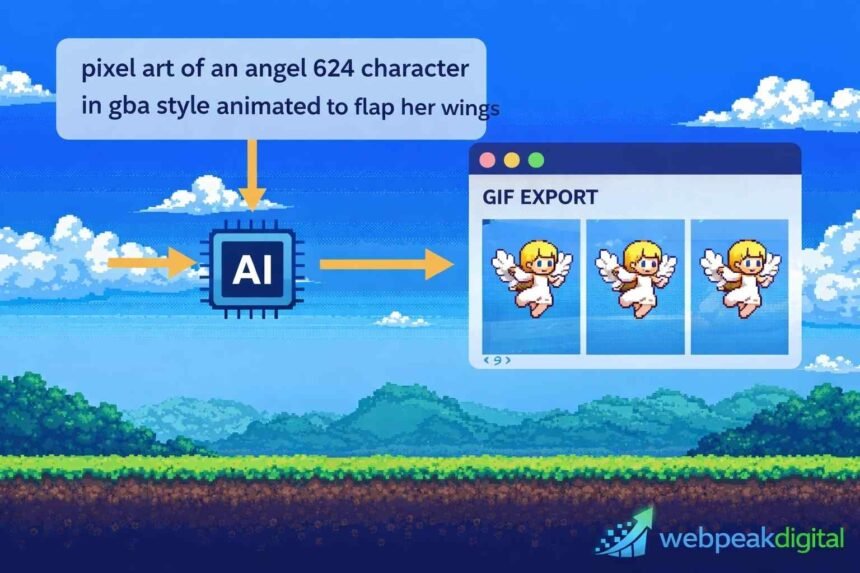
The term angel 624 gba sprite prompts gif ai generator is commonly used to describe an AI-assisted workflow for creating retro, Game Boy Advance–style sprite animations using structured text prompts. Rather than referring to a single branded tool, it reflects how developers and creators combine prompt engineering with AI image models to generate animated sprite assets, often previewed as GIFs.
This approach is most relevant in retro game development, rapid prototyping, and pixel art experimentation, where speed and iteration matter more than polished final assets. By applying GBA-specific constraints—such as limited color palettes, low resolution, and short animation loops AI-generated sprites can closely resemble classic handheld game visuals while reducing manual workload.
Understanding how these generators work, who uses them, and where their limitations lie is essential for anyone considering AI-generated sprites in a production or commercial context. Without clear expectations around format, style, and usage rights, teams can quickly run into technical or legal issues later in development.
What Is an Angel 624 GBA Sprite Prompts GIF AI Generator
An Angel 624 GBA sprite prompts GIF AI generator is a workflow that uses AI models to create Game Boy Advance–style pixel sprite animations from structured text prompts, often exporting the result as animated GIFs.
-
It is not a single proprietary tool
-
It describes a prompt-driven sprite generation process
-
It focuses on retro GBA constraints and short animation loops
This term is used to describe a category of AI-assisted sprite creation.
Definition of GBA-style sprite generation with AI
GBA-style sprite generation with AI means producing pixel art sprites that follow the visual and technical limits of the Game Boy Advance.
-
Low-resolution sprites
-
Limited color palettes
-
Simple shading and outlines
AI models must be constrained to avoid modern pixel art styles.
Meaning of “Angel 624” in sprite prompt workflows
“Angel 624” functions as a named character or example prompt reference rather than an industry standard.
-
Acts as a placeholder character identity
-
Helps maintain consistency across iterations
-
Commonly used in demonstrations or testing
It behaves like a prompt label, not a specification.
How GIF output fits into game asset creation
GIF output serves as a preview format rather than a production-ready asset.
-
Useful for reviewing animation flow
-
Easy to share and validate visually
-
Not typically used directly in game engines
Most pipelines convert GIFs into sprite sheets later.
Who Uses GBA Sprite Prompt AI Generators
GBA sprite prompt AI generators are primarily used by professionals and hobbyists who need fast, retro-style animation assets without full manual pixel art workflows.
-
Users prioritize speed and iteration
-
Most understand AI output requires refinement
-
Use cases vary by experience level
These tools support early and mid-stage production.
Indie game developers and hobbyists
Indie developers rely on AI sprites to reduce early development overhead.
-
Faster character prototyping
-
Lower upfront art costs
-
Easier experimentation
This supports rapid gameplay testing.
Pixel artists and retro game designers
Experienced artists use AI as a supporting tool.
-
Generate rough animation bases
-
Explore variations quickly
-
Reduce repetitive frame work
Final quality control remains manual.
Content creators and animation prototypes
Creators use AI sprite GIFs for visualization and education.
-
Demonstrations and tutorials
-
Concept previews
-
Non-production animations
Precision is less critical than clarity.
How AI Sprite Prompt Generation Works
AI sprite prompt generation works by translating text-based descriptions into pixel-based visual frames that simulate motion through sequence ordering.
-
Prompts define structure and style
-
Models generate multiple frames
-
Outputs require review and adjustment
Results depend heavily on prompt clarity.
Text prompts as input signals for sprite creation
Prompts act as the primary control mechanism.
-
Define character type
-
Specify pose or motion
-
Set stylistic boundaries
Ambiguous prompts lead to unstable output.
Style constraints for Game Boy Advance aesthetics
GBA aesthetics require explicit limitation.
-
Resolution caps
-
Palette restrictions
-
Minimal shading
Without constraints, AI defaults to modern styles.
Frame generation and animation sequencing
Animation is created through sequential frames.
-
Each frame represents motion progression
-
Frame order defines smoothness
-
Inconsistency causes jitter
Sequencing quality affects usability.
Understanding GBA Sprite Style Requirements
GBA sprite style requirements are defined by hardware-era limitations that modern AI models do not naturally follow.
-
Strict visual rules
-
Minimal animation frames
-
Emphasis on readability
These rules must be enforced intentionally.
Resolution, palette, and pixel density standards
GBA sprites follow narrow technical ranges.
-
Common sizes: 16×16 to 64×64
-
Shared palettes across frames
-
Uniform pixel density
Breaking standards reduces authenticity.
Animation limits in classic GBA sprites
Hardware constraints limited animation complexity.
-
Low frame counts
-
Reused frames
-
Slower perceived motion
AI output should reflect these limits.
Differences between GBA and modern pixel art
Modern pixel art uses higher fidelity.
-
Larger canvases
-
More colors and gradients
-
Smoother motion
These differences must be accounted for in prompts.
Writing Effective Sprite Prompts for Angel-Style Characters
Effective sprite prompts clearly define character identity, movement, and constraints to maintain consistency across frames.
-
Prompts must be specific
-
Simplicity improves results
-
Consistency reduces errors
Angel-style characters require careful balance.
Core prompt elements: character, pose, action
Every prompt should include three core elements.
-
Character description
-
Starting pose
-
Defined action
Omitting any weakens output quality.
Motion descriptors for animated GIF output
Motion must be described explicitly.
-
Direction and speed
-
Loop behavior
-
Frame count expectations
Vague motion leads to unstable animation.
Prompt modifiers for consistency across frames
Modifiers stabilize generation.
-
Fixed camera angle
-
Locked lighting
-
Stable color palette
These reduce visual drift.
GIF vs Sprite Sheet Outputs
GIFs and sprite sheets serve different roles in development pipelines and should not be treated interchangeably.
-
GIFs support review
-
Sprite sheets support runtime use
-
Conversion is usually required
Choosing the wrong format causes delays.
When animated GIFs are the better choice
GIFs are best for validation.
-
Quick playback
-
Easy sharing
-
Clear visual feedback
They are not optimized for performance.
Use cases for sprite sheets in game engines
Sprite sheets are required for implementation.
-
Engine-compatible
-
Frame-level control
-
Efficient memory usage
They are the production standard.
Export considerations for development pipelines
Export quality affects downstream work.
-
Transparency handling
-
Frame alignment
-
Consistent dimensions
Poor exports increase rework.
Benefits of Using AI for Retro Sprite Generation
AI significantly reduces the time and cost required to produce usable retro sprite animations during early development stages.
-
Faster iteration
-
Lower cost barriers
-
Increased experimentation
Quality still requires oversight.
Speed and cost efficiency compared to manual pixel art
AI accelerates basic production.
-
Minutes instead of days
-
Lower reliance on specialist labor
-
Rapid visual testing
Manual refinement remains necessary.
Rapid prototyping for game concepts
AI enables fast idea validation.
-
Character swaps
-
Animation testing
-
Gameplay pacing checks
This improves decision-making.
Accessibility for non-artists
AI lowers technical barriers.
-
Designers can create visuals
-
Programmers can prototype alone
-
Teams move faster
This expands participation.
Limitations and Creative Risks of AI Sprite Generators
AI sprite generators introduce technical and creative risks that must be managed carefully.
-
Inconsistencies are common
-
Output quality varies
-
Legal clarity is limited
Awareness reduces downstream problems.
Inconsistent frame alignment issues
Frame alignment is a frequent problem.
-
Shifting sprite positions
-
Broken hitboxes
-
Manual correction required
This impacts gameplay reliability.
Style drift in multi-frame animations
Style drift occurs across longer sequences.
-
Changing outlines
-
Palette variation
-
Loss of cohesion
Long animations increase risk.
Intellectual property and originality concerns
Ownership remains unclear in many cases.
-
Training data sources vary
-
Similarity to existing assets is possible
-
Responsibility lies with the user
Caution is advised for commercial projects.
Best Practices for GBA Sprite Prompt Workflows
Reliable results come from structured workflows rather than one-off prompt attempts.
-
Iteration matters
-
Constraints improve stability
-
Human review is essential
Process discipline improves outcomes.
Iterative prompting for animation accuracy
Iteration refines output.
-
Start simple
-
Adjust incrementally
-
Compare results systematically
This reduces unexpected changes.
Locking visual parameters across frames
Consistency must be enforced.
-
Fixed scale
-
Fixed palette
-
Fixed camera
These reduce visual noise.
Combining AI output with manual refinement
Manual work remains critical.
-
Clean up artifacts
-
Adjust timing
-
Polish details
AI accelerates, not replaces, craftsmanship.
Popular AI Tools Used for GBA Sprite and GIF Generation
Multiple tool categories support GBA-style sprite generation, each serving a different role in the workflow.
-
Prompt-first tools
-
Image-based tools
-
Post-processing tools
Most workflows combine several tools.
Prompt-based sprite generators
These rely entirely on text input.
-
Fast ideation
-
Variable quality
-
Limited control
Best for early concepts.
Image-to-animation AI tools
These animate existing sprites.
-
Better consistency
-
More control
-
Requires base art
Useful for refinement.
Supporting tools for cleanup and optimization
Cleanup tools finalize assets.
-
Pixel editors
-
Sprite packers
-
Optimization utilities
They prepare assets for production.
Common Mistakes When Generating AI Sprite GIFs
Most issues arise from poor prompt discipline or misunderstanding retro constraints.
-
Overcomplex prompts
-
Ignoring limitations
-
Improper exports
These mistakes slow development.
Overloading prompts with conflicting instructions
Too much detail reduces clarity.
-
Conflicting styles
-
Multiple actions
-
Mixed references
Simple prompts perform better.
Ignoring GBA hardware constraints
Modern defaults break authenticity.
-
Excessive colors
-
High resolution
-
Smooth gradients
Constraints must be stated.
Exporting unusable animation formats
Incorrect exports cause rework.
-
No transparency
-
Wrong dimensions
-
Improper frame order
Exports must match engine needs.
Comparing AI Sprite Generators vs Traditional Pixel Art
AI sprite generation and traditional pixel art serve different roles depending on project stage and quality requirements.
-
AI favors speed
-
Manual art favors control
-
Hybrid workflows are common
Each has clear tradeoffs.
Time and skill requirements
AI lowers entry barriers.
-
Faster output
-
Less technical skill
-
More iteration
Manual art requires expertise.
Quality control differences
Manual art offers predictability.
-
Full control
-
Stable style
-
Precise animations
AI trades control for speed.
When manual pixel art is still preferable
Some scenarios demand manual work.
-
Final production assets
-
Signature art styles
-
Commercial polish
AI is best earlier in development.
Practical Checklist for Creating GBA Sprite GIFs with AI
A structured checklist reduces errors and rework during sprite generation.
-
Planning prevents waste
-
Testing reveals issues early
-
Validation ensures usability
Checklists support consistency.
Pre-prompt planning checklist
Preparation improves outcomes.
-
Define sprite size
-
Choose animation type
-
Set palette limits
Planning saves iteration time.
Prompt testing and iteration steps
Testing should follow a process.
-
Generate short loops
-
Review frame stability
-
Adjust prompts carefully
Small changes work best.
Final export and validation checks
Validation prevents pipeline issues.
-
Check alignment
-
Verify transparency
-
Confirm compatibility
Final checks reduce surprises.
Frequently Asked Questions
What is an angel 624 gba sprite prompts gif ai generator used for?
An angel 624 gba sprite prompts gif ai generator is used to create retro, Game Boy Advance–style sprite animations from text prompts, usually exported as animated GIFs for preview or validation. It helps developers and creators quickly visualize character motion before converting assets into sprite sheets for actual game use.
Are AI-generated GBA sprite GIFs production-ready for games?
No, most AI-generated GBA sprite GIFs are not production-ready. They are best used for concept testing, animation review, and iteration. Final game assets usually require manual cleanup, frame alignment, palette correction, and conversion into engine-compatible sprite sheets.
Do AI sprite generators remove the need for pixel artists?
No, AI sprite generators do not remove the need for pixel artists. They reduce repetitive work and speed up early-stage experimentation, but experienced artists are still required for style control, animation polish, consistency, and final asset approval—especially in commercial projects.